Mobile Technology and Apps in 2026: Latest Trends, Benefits and Future
Introduction
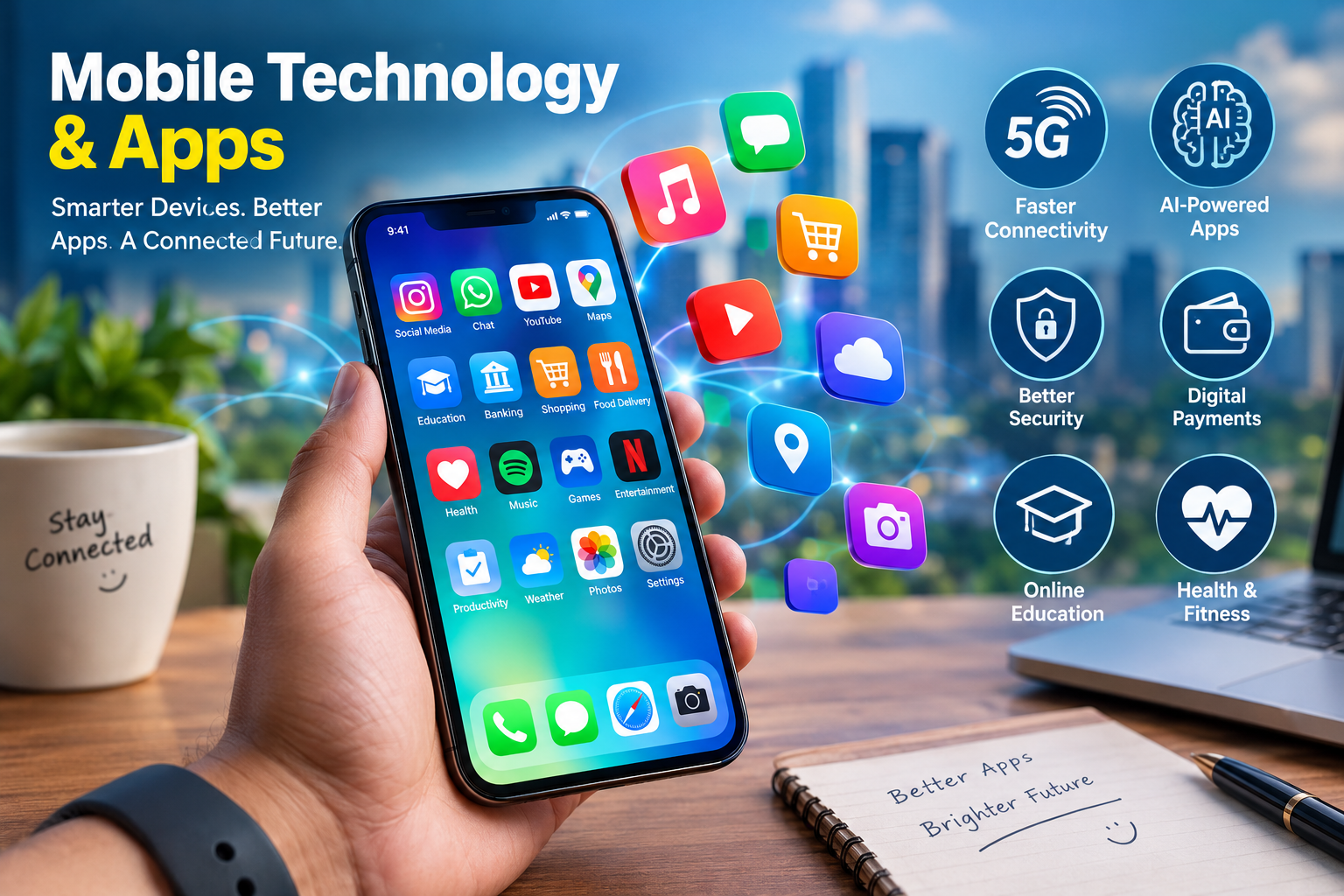
Mobile technology has become an essential part of modern life. From waking up to an alarm on a smartphone to making online payments, attending virtual meetings, watching videos and connecting with friends, mobile devices help people complete countless tasks every day. What was once a simple communication tool has evolved into a powerful digital assistant that supports education, business, entertainment, healthcare and personal productivity.
In 2026, mobile technology is moving beyond traditional smartphones and applications. Artificial intelligence (AI), faster internet connectivity, cloud computing, digital payments and smarter mobile software are changing how people interact with technology. Apps are becoming more personalized, convenient and capable of helping users solve everyday problems.
In India, mobile technology is particularly important because smartphones provide access to online services, learning resources, entertainment and financial tools for millions of people. According to Sensor Tower’s 2026 report on India’s mobile app market, the country remains one of the world’s largest markets for app downloads, with growing interest in AI, productivity and digital services.
But what exactly is mobile technology, which apps are changing our lives, and what can we expect in the future? Let’s explore the major trends, benefits, challenges and opportunities shaping the mobile technology industry.
1. What Is Mobile Technology?
Mobile technology refers to the devices, networks, software and systems that allow people to communicate, access information and perform digital activities while on the move.
It includes smartphones, tablets, wireless networks, mobile applications, wearable devices and cloud-based services. These technologies work together to provide convenient access to information and services from almost anywhere with a suitable network connection.
For example, a person can use a smartphone to book a train ticket, transfer money, attend an online class or navigate an unfamiliar city. These activities are possible because mobile hardware, internet connectivity and applications work together.
The main components of mobile technology include:
- Smartphones: Devices used for communication, photography, browsing and digital services.
- Mobile networks: Technologies such as 4G and 5G that connect devices to the internet.
- Mobile applications: Software designed to perform specific tasks on smartphones and tablets.
- Cloud computing: Online systems that store information and provide services over the internet.
- Artificial intelligence: Technology that can assist with writing, translation, recommendations and other tasks.
Together, these components form the foundation of today’s mobile-first digital world.
2. The Growing Importance of Mobile Apps
Mobile applications have transformed smartphones into multipurpose tools. Instead of relying on separate devices for every activity, users can now manage many parts of their lives through a single phone.
Communication apps help people stay connected with family, friends and colleagues. Banking applications allow users to check account balances and transfer money. Shopping apps make it possible to purchase groceries, clothing and electronics without visiting a physical store.
Educational applications provide access to online courses, language lessons, digital libraries and practice tests. Entertainment apps offer movies, music, games, podcasts and short videos.
Mobile apps are also important for businesses. Companies use them to communicate with customers, accept payments, manage orders and provide customer support.
As internet access and smartphone capabilities improve, applications are becoming more sophisticated. Developers are increasingly focusing on simple interfaces, faster performance, accessibility and personalized experiences.
3. Artificial Intelligence Is Transforming Mobile Apps
Artificial intelligence is one of the most important developments in mobile technology. AI-powered applications can help users write content, summarize documents, translate languages, generate ideas and organize information.
For students, AI tools can explain difficult concepts, create revision questions and help organize study schedules. Content creators can use AI to brainstorm article ideas, prepare outlines and improve their writing. Professionals can use AI assistants to summarize lengthy documents or prepare meeting notes.
AI is also improving smartphone cameras. Depending on the device, intelligent software can recognize scenes, reduce image noise, enhance portraits and improve photographs taken in low light.
Other useful applications include voice recognition, predictive text, spam detection and smart search.
However, AI tools are not always accurate. They can produce incorrect information, misunderstand instructions or generate misleading content. Users should verify important facts instead of accepting every AI-generated answer without checking.
Privacy is another important consideration. Before using an AI application, people should understand what information it collects and avoid uploading sensitive personal or financial information unnecessarily.
The future of mobile AI will likely focus on making applications more helpful, responsive and personalized while improving privacy and reliability.
4. The Role of 5G in Mobile Technology
Faster internet connectivity has played a major role in the development of mobile applications. Fourth-generation networks helped popularize video streaming, online gaming and digital communication. Fifth-generation technology, commonly known as 5G, offers the potential for higher speeds, greater network capacity and lower latency under suitable conditions.
These improvements can benefit many activities, including high-quality video calls, cloud gaming, large file transfers and connected devices.
For example, a business professional may be able to participate in a video conference while travelling. Students can access online learning resources, and creators can upload large video files more efficiently when network conditions support it.
In India, 5G expansion is an important part of the country’s digital development. Nevertheless, actual performance depends on network coverage, device compatibility, congestion and the user’s mobile plan.
It is also important to remember that 5G does not automatically make every application faster. An app’s performance can still depend on its servers, software design and internet connection.
As mobile networks continue to evolve, reliable connectivity will remain essential for advanced applications and digital services.
5. Popular Categories of Mobile Apps
Different mobile applications serve different needs. Understanding these categories helps users choose the right tools for their daily activities.
Social Media and Communication Apps
Social media applications allow people to share photographs, videos, opinions and updates. Messaging and video-calling apps make communication possible across long distances.
These platforms are useful for personal communication, community building, marketing and content creation. Businesses can also use social media to reach potential customers and build brand awareness.
However, excessive use can affect concentration and reduce the time available for offline activities. Managing notifications and setting screen-time limits can help users maintain a healthier balance.
Education and Learning Apps
Educational applications have made learning more flexible. Students can access video lessons, digital textbooks, quizzes and interactive learning materials from their smartphones.
Language-learning applications help users practise vocabulary and pronunciation. Competitive-exam apps provide mock tests and revision resources, while productivity tools support note-taking and study planning.
These apps are especially useful for people who cannot always attend in-person classes. However, students should check the quality of educational content and use reliable sources for exam preparation.
Banking and Digital Payment Apps
Mobile banking and digital payment applications have made everyday financial transactions more convenient. Users can check balances, pay bills, transfer money and review transactions through supported services.
In India, the Unified Payments Interface (UPI) has helped make digital payments widely accessible. Users can pay participating merchants and transfer money through compatible banking and payment applications.
Convenience must be balanced with security. Users should never share their UPI PIN, banking password or one-time password with another person. They should also verify payment requests before approving transactions.
Health and Fitness Apps
Health and fitness applications can help people track physical activity, record workouts, monitor sleep patterns and establish healthy routines.
Some applications work with smartwatches and fitness bands to collect additional information. Others provide guided exercises, meditation sessions and meal-planning features.
These tools can encourage healthier habits, but their measurements may not always be precise. Fitness applications should not replace professional medical advice or emergency care.
Shopping and Food Delivery Apps
Shopping applications allow customers to compare products, read reviews, track orders and discover discounts. Food delivery services help people order meals from participating restaurants.
These apps save time and provide convenient access to a wide range of products and services. However, customers should compare prices, review return policies and purchase from trustworthy sellers.
Avoiding unnecessary purchases and checking the final checkout price can also help users manage their spending.
Entertainment and Gaming Apps
Video-streaming platforms, music services, short-video applications and mobile games are among the most familiar uses of smartphones.
They provide relaxation, creative opportunities and access to content from different parts of the world. Independent creators can also publish videos, music and other digital content for large audiences.
The main challenge is excessive screen time. Users can benefit from setting reasonable limits and choosing content that supports their interests rather than endlessly scrolling through recommendations.
6. How Mobile Technology Is Helping Students
Mobile technology has changed the way students learn and prepare for examinations. A smartphone can provide access to educational videos, online libraries, dictionaries, digital flashcards and virtual classrooms.
Students can use applications to organize assignments, create revision schedules and collaborate with classmates. AI-powered tools may also help explain complex subjects in simpler language.
For example, a student preparing for a science examination can watch an explanatory video, review digital notes and practise questions using a mobile device.
However, technology works best when it supports active learning rather than replacing it. Copying answers without understanding them can weaken problem-solving skills. Notifications, games and social media can also interrupt concentration.
To use mobile technology effectively, students should choose trusted educational apps, verify information, take breaks and practise solving problems independently.
7. Mobile Technology and Business Growth
Mobile technology has created new opportunities for businesses of all sizes. Small businesses can promote products through social media, communicate with customers through messaging applications and accept digital payments without building expensive physical infrastructure.
Mobile commerce allows customers to browse products, compare prices and place orders directly from their phones. Businesses can also use mobile-friendly websites to reach audiences who primarily access the internet through smartphones.
For website owners and digital publishers, mobile technology creates opportunities to reach readers wherever they are. A responsive website, readable text, fast-loading pages and simple navigation can improve the experience for mobile visitors.
Businesses should also consider accessibility, customer privacy and secure payment processing. A convenient digital experience is valuable only when users can trust the service.
As more services move online, mobile-friendly design is becoming an important part of business strategy.
8. Mobile Security and Privacy: What Users Should Know
Although mobile technology offers many benefits, it also introduces security and privacy risks. Cybercriminals may use fake applications, fraudulent messages, phishing websites and impersonation tactics to steal information.
A few basic precautions can significantly improve mobile security.
Download apps from trusted sources. Check the developer’s identity, reviews and requested permissions before installing an application.
Keep your phone updated. Operating system and app updates may contain important security fixes.
Use strong authentication. Set a secure screen lock and enable two-factor authentication where available.
Avoid suspicious links. Do not open unexpected links or attachments simply because they appear to come from a familiar contact.
Review app permissions. A simple utility may not need access to your contacts, microphone or location.
Protect financial information. Never disclose your PIN, password or OTP to someone who contacts you unexpectedly.
Back up important data. Regular backups can help you recover photographs, documents and contacts if a device is lost or damaged.
Public Wi-Fi also requires caution, particularly when accessing sensitive accounts. Users should verify that websites and applications are legitimate and avoid ignoring security warnings.
Digital safety is not only a technical issue. It also depends on recognizing suspicious behaviour and thinking carefully before sharing information.
9. The Challenges of Modern Mobile Technology
Despite its advantages, mobile technology presents several challenges.
Smartphone Addiction and Distraction
Frequent notifications and endless content feeds can make it difficult to concentrate. Some people spend more time on their phones than they intend to.
Turning off unnecessary notifications, setting app limits and keeping phones away during focused work can help.
Privacy Concerns
Some applications collect information about location, device usage and user behaviour. People should review privacy settings and share only the information necessary to use a service.
Digital Fraud
Fake customer-support numbers, fraudulent payment requests and phishing messages can cause financial losses. Users should verify the identity of anyone requesting money or confidential information.
Device Cost and Electronic Waste
Advanced smartphones can be expensive, and frequent upgrades contribute to electronic waste. Choosing a reliable device that meets actual needs and recycling old electronics responsibly can reduce unnecessary waste.
Unequal Access to Technology
Not everyone has access to affordable devices, reliable internet or digital skills. Services that support regional languages, accessibility and lower-cost devices can help make technology more inclusive.
Addressing these challenges is essential for ensuring that mobile technology benefits society as a whole.
10. The Future of Mobile Technology and Apps
The next generation of mobile technology is likely to focus on intelligence, personalization, connectivity and convenience.
More Personalized AI Assistants
AI assistants may become better at understanding natural language, helping with daily tasks and working across different applications. Their usefulness will depend on accuracy, privacy controls and integration with services users trust.
Smarter Smartphones
Future smartphones may include more advanced image processing, improved battery management and enhanced on-device AI. Some features may work without an internet connection, depending on the phone’s hardware and software.
Augmented Reality
Augmented reality (AR) adds digital information to views of the real world. Mobile AR can help people visualize furniture in a room, explore educational models or navigate certain environments.
Connected Devices
Smartwatches, wireless earbuds, home appliances and other connected devices are becoming part of wider digital ecosystems. Smartphones often serve as the central control point for these devices.
Better Digital Accessibility
Voice interfaces, live captions, translation features and screen-reading tools can make mobile technology easier to use for people with different needs.
More Advanced Mobile Networks
Research into future network technologies, including 6G, may enable new applications and more connected systems. However, widespread 6G deployment remains a future development rather than a feature consumers should expect from today’s phones.
The direction is clear: mobile technology is becoming more integrated into everyday life, although the pace of change will vary across devices, regions and services.
11. How to Choose the Right Mobile Apps
With millions of applications available, choosing the right ones can be challenging. Instead of installing every trending app, users should focus on their needs and the value an application provides.
Start by identifying the task you want to complete. A student may need a note-taking app, a business owner may need an invoicing tool, and a traveller may need navigation and booking applications.
Next, check the following factors:
- Reliability: Does the app work consistently?
- Security: Is the developer trustworthy, and are permissions reasonable?
- Ease of use: Is the interface clear and accessible?
- Cost: Are subscriptions, advertisements or in-app purchases involved?
- Reviews: Do users report recurring problems?
- Updates: Is the application maintained and compatible with your device?
- Privacy: Does the app explain how personal information is handled?
It is also sensible to remove applications that are no longer useful. Fewer unnecessary apps can mean fewer notifications, less clutter and more control over personal data.
Conclusion
Mobile technology and applications have become powerful tools for communication, education, entertainment, business and everyday problem-solving. Smartphones now offer access to services that once required multiple devices or physical visits, while AI, 5G and cloud computing continue to expand what mobile applications can do.
For people in India, mobile technology creates opportunities to learn new skills, participate in the digital economy, make payments and access services more conveniently. At the same time, security risks, privacy concerns, excessive screen time and unequal access remain important issues.
The best way to benefit from mobile technology is to use it thoughtfully. Choose trustworthy apps, protect personal information, verify important digital content and maintain a healthy balance between online and offline activities.
As technology continues to evolve, the most valuable mobile applications will not simply be the ones with the most features. They will be the ones that solve real problems, respect users’ privacy and make everyday life easier.
Mobile technology is more than a collection of devices and apps. It is an evolving part of how people learn, work, communicate and experience the world.
Frequently Asked Questions (FAQs)
1. What is mobile technology?
Mobile technology includes smartphones, wireless networks, mobile applications and related systems that allow people to communicate, access information and use digital services while on the move.
2. Which mobile apps are most useful in daily life?
Useful apps include messaging tools, digital payment applications, navigation services, educational platforms, banking apps, productivity tools and health or fitness trackers. The best choice depends on individual needs.
3. How is AI changing mobile applications?
AI helps mobile apps perform tasks such as translation, writing assistance, image enhancement, content recommendations, voice recognition and information summarization.
4. Is mobile technology safe to use?
Mobile technology can be used more safely by installing trusted apps, updating software, reviewing permissions, enabling strong authentication and avoiding suspicious links or payment requests.
5. What is the future of mobile technology?
Future developments may include more capable AI assistants, improved connectivity, smarter wearable integration, augmented reality and better accessibility features.
6. How can mobile apps help students?
Students can use educational apps for online classes, revision, practice tests, digital notes, language learning and time management. They should verify information and focus on understanding concepts.
7. What are the disadvantages of mobile technology?
Potential disadvantages include distraction, privacy risks, online fraud, excessive screen time, electronic waste and unequal access to reliable devices and internet services.
8. How can I make my smartphone more secure?
Keep your device updated, use a secure screen lock, download apps from trusted sources, review permissions, back up important information and never share confidential banking credentials or OTPs.




Leave a Reply