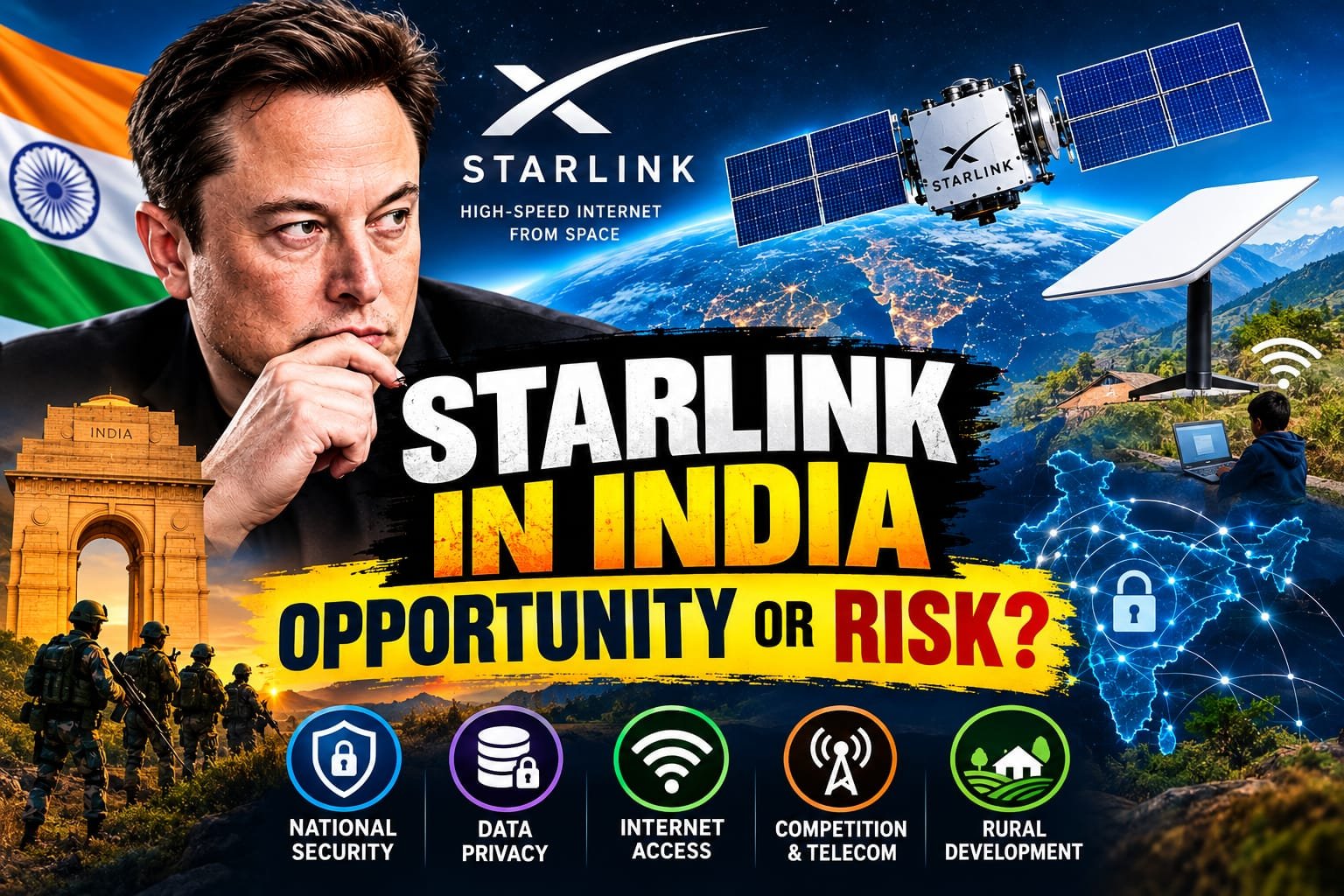
Starlink Controversy: Why Elon Musk’s Satellite Internet Is Raising Security Concerns in India
India Handle | Technology & National News | October 16, 2026
Introduction
Starlink, the satellite internet service operated by Elon Musk’s SpaceX, has become the centre of a growing debate in India. While the technology promises to bring high-speed internet to remote villages, mountains and areas with limited connectivity, concerns about national security, data privacy and government control have raised questions about its entry into the Indian market.
The debate has intensified in October 2026, with calls from some organisations to halt Starlink’s commercial rollout until security concerns are addressed. India’s satellite internet approval process has also become a subject of public disagreement between Elon Musk and major Indian telecom companies.
What Is Starlink?
Starlink is a satellite-based broadband internet service developed by SpaceX. Unlike conventional internet services that depend heavily on cables, fibre networks or nearby mobile towers, Starlink uses a network of satellites orbiting relatively close to Earth to deliver internet connectivity.
Customers generally use a specialised satellite dish and associated equipment to connect to the network.
This technology could be particularly useful in remote areas where installing traditional internet infrastructure is expensive or difficult. It could also help provide connectivity during natural disasters when ground-based communication networks are damaged.
Why Is Starlink Facing Opposition in India?
The main debate concerns national security, data sovereignty and regulatory oversight.
1. National Security Concerns
Satellite internet can provide connectivity across large geographical areas, including locations where conventional telecom infrastructure is limited.
Some organisations have questioned whether Indian authorities would have sufficient oversight of a foreign-operated satellite network, particularly during emergencies or security-sensitive situations.
These concerns do not automatically mean that Starlink is unsafe. They highlight the need for clear rules governing network operations, lawful access, emergency restrictions and compliance with Indian law.
2. Data Privacy and Sovereignty
Another important question is how internet traffic, customer information and other sensitive data will be managed.
Indian authorities must assess whether satellite internet operators can meet the country’s requirements concerning data protection, lawful interception and national security.
The key challenge is to ensure that international technology companies follow Indian regulations while protecting users’ privacy and maintaining reliable internet services.
3. Can the Government Restrict Internet Access During Emergencies?
India sometimes orders temporary internet restrictions in specific areas during serious law-and-order situations.
Critics of Starlink’s proposed entry have questioned whether a satellite-based network could be restricted effectively in such circumstances.
The issue requires technical and regulatory examination. Satellite internet is not inherently impossible to regulate, but authorities need enforceable arrangements to ensure compliance with lawful government directions.
4. Competition With Indian Telecom Companies
Starlink’s entry could increase competition in India’s satellite broadband market.
Companies associated with Reliance Jio and Bharti Airtel-backed Eutelsat OneWeb are also pursuing satellite connectivity opportunities. Elon Musk has publicly criticised delays affecting Starlink’s entry, while Indian authorities have rejected allegations of unfair treatment.
As of October 16, 2026, Starlink’s commercial launch in India remains subject to outstanding regulatory and security requirements. Possessing certain licences or authorisations does not necessarily mean a company has received every approval needed to begin commercial operations.
How Could Starlink Benefit India?
Despite the controversy, satellite internet could offer several potential benefits.
Better connectivity in rural areas: Villages far from fibre-optic networks could gain another option for accessing the internet.
Support during disasters: Satellite connectivity could help emergency workers communicate when conventional networks are disrupted.
Education and healthcare: Schools, medical facilities and community institutions in remote locations could benefit from improved access to online services, subject to affordability and reliable coverage.
Business opportunities: Better connectivity could help small businesses, tourism operators and other organisations in underserved regions.
However, these benefits will depend on pricing, equipment costs, network performance and the regulatory conditions under which the service operates.
What Does This Mean for India’s Digital Future?
India faces an important policy challenge: encouraging technological innovation while protecting national security and citizens’ data.
A transparent approval process would help companies understand the requirements they must meet. At the same time, independent security assessments and effective regulatory supervision would help build public confidence.
Satellite internet should not be treated as a replacement for every existing connectivity option. Instead, it could complement fibre broadband and mobile networks, particularly in areas where traditional infrastructure is difficult to establish.
Conclusion
Starlink’s proposed entry into India represents more than a competition between global technology companies and domestic telecom operators. It raises important questions about connectivity, digital sovereignty, national security and the future of India’s internet infrastructure.
The technology could improve access to the internet for millions of people, but its success will depend on meeting India’s regulatory requirements and addressing legitimate security concerns.
For now, the central question is not simply whether Starlink should enter India, but how satellite internet can be introduced in a way that balances innovation, consumer choice and national interests.
India Handle will continue to follow developments in satellite internet, technology policy and India’s digital economy.




Leave a Reply