Why Did Indian IT Stocks Rally This Week? 5 Key Reasons
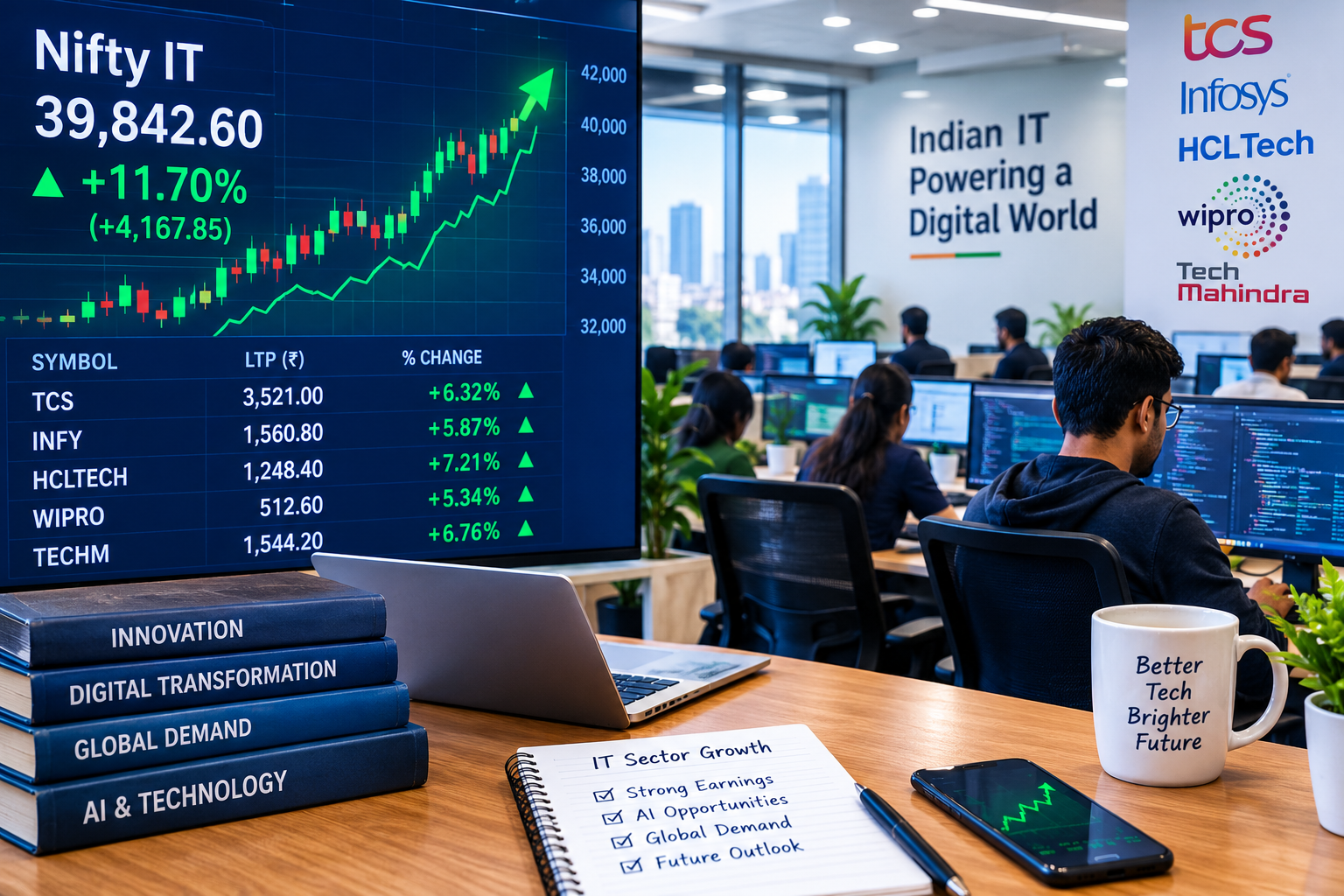
Why Did Indian IT Stocks Rally This Week? 5 Key Reasons Behind the October 2026 Surge
Introduction
Indian IT stocks have made headlines this week after a powerful recovery surprised investors and market watchers. Shares of major technology companies, including Tata Consultancy Services (TCS), Infosys, HCLTech, Wipro, and Tech Mahindra, attracted renewed buying interest as investors reassessed the outlook for India’s technology services industry.
The rally came after a difficult period for technology stocks, when concerns about artificial intelligence (AI), expensive valuations, and cautious corporate spending weighed on investor confidence.
However, stronger-than-expected quarterly earnings, improving sentiment, and opportunities created by the global technology sell-off helped change the mood in the Indian market.
According to Reuters, the Nifty IT index surged 11.7% during the week ending October 16, 2026, marking its strongest weekly performance in 18 years. The Nifty 50 and Sensex also recorded their strongest weekly gains in approximately six months. These figures highlight how significantly investor sentiment changed over a short period.
But what caused this sudden recovery? Why are investors returning to Indian IT companies, and can the rally continue?
Let’s examine the five major reasons behind this week’s IT stock rally, the role of artificial intelligence, the latest earnings developments, and the risks investors should understand before drawing conclusions.
1. Strong Quarterly Earnings Improved Investor Confidence
One of the most important reasons behind the IT stock rally was the release of quarterly results that were better than many investors had expected.
Company earnings play a crucial role in determining how investors value a business. When a company reports stronger profitability or better financial performance than anticipated, its shares can rise as investors revise their expectations.
HCLTech was one of the key companies that helped improve sentiment. Its September-quarter results reassured investors about demand for technology services and supported buying across the wider IT sector.
The company’s performance helped challenge some of the pessimism that had surrounded technology stocks in recent months.
TCS also attracted attention following its latest results. Reporting covered by financial media indicated that the company delivered year-on-year growth in consolidated net profit for the September quarter, helping strengthen sentiment toward large Indian IT companies.
However, investors should not judge a company by one financial figure alone. Revenue growth, operating margins, cash flow, client demand, and management guidance all influence whether strong results can translate into sustainable business growth.
The broader lesson is that investors became more willing to reconsider IT stocks after earnings failed to produce the negative surprises that many had feared.
When expectations are low, even moderately encouraging results can lead to a sharp share-price recovery.
2. Investors Started Looking for Value After the Sell-Off
Another important reason behind the rally was value buying.
Before the recovery, concerns about AI disruption and weaker technology spending had put pressure on Indian IT shares. When stock prices fall significantly, some investors begin evaluating whether companies have become attractively valued relative to their long-term earnings potential.
This does not mean every falling stock automatically becomes cheap. A company’s valuation must be considered alongside its expected growth, profitability, competitive position, and business risks.
Nevertheless, lower prices can create opportunities for investors who believe the market has become excessively pessimistic.
During the October rally, investors returned to several large IT companies after the sector’s earlier weakness.
According to market coverage published by The Economic Times and Business Standard on October 15, the Nifty IT index had gained approximately 8–9% over three sessions, with improving earnings, value buying, and changing investor sentiment contributing to the recovery. The index subsequently extended its gains during the week.
This helps explain why the recovery was so powerful. When many investors have already reduced their exposure to a sector, a change in sentiment can trigger fresh buying.
Short-term traders may also close bearish positions, adding to the speed of a recovery.
However, investors must remember that a rebound after a sell-off does not necessarily mean a company’s long-term problems have disappeared.
3. Global AI Stock Weakness Changed Investor Sentiment
Artificial intelligence has become one of the biggest influences on global technology markets.
Investors have poured money into companies associated with AI chips, cloud computing, data centres, and advanced software. At the same time, questions have emerged about the enormous cost of AI infrastructure and how quickly these investments will generate profits.
During October 2026, a sell-off in some global AI-linked stocks raised concerns about valuations, capital expenditure, and the time required to earn returns from AI investments.
Interestingly, this weakness also contributed to renewed interest in Indian IT services companies.
Why?
Indian IT firms have business models that differ from those of semiconductor manufacturers and companies making large investments in AI infrastructure. They provide services such as software development, consulting, application maintenance, cloud migration, cybersecurity, and business process management.
When investors reconsider expensive technology investments elsewhere, they may look for opportunities in other parts of the technology sector.
Some investors viewed established Indian IT services companies as potential beneficiaries of this change in sentiment, particularly after their share prices had weakened.
However, this relationship is not straightforward.
Indian IT companies are also exposed to AI-related risks. AI tools may automate some traditional services, increase competition, put pressure on pricing, and change how software projects are delivered.
At the same time, AI could create new demand for consulting, integration, cloud infrastructure, data management, and enterprise transformation.
The important question is not whether AI is good or bad for Indian IT companies in general. It is whether each company can adapt its services, pricing, workforce, and business model quickly enough to remain competitive.
4. Investors Are Reassessing the Future of AI and Traditional IT Services
The AI debate has become more complicated than the simple argument that artificial intelligence will replace software companies.
Some investors fear that AI-powered coding tools and automated systems could reduce the number of employees needed to complete traditional IT projects.
If clients can complete more work using fewer billable hours, service providers may face pressure on revenue and pricing.
This is a serious consideration for an industry that has historically depended heavily on skilled employees and large technology projects.
However, the other side of the argument is equally important.
Businesses adopting AI need help integrating new systems into existing infrastructure. They may require data preparation, cybersecurity, governance, application redesign, cloud migration, and ongoing technical support.
Large organisations also operate complicated systems that cannot always be replaced quickly by a new AI tool.
Indian IT companies could benefit if they become trusted partners for these changes.
For example, a bank adopting AI may need assistance integrating the technology into its existing software, protecting sensitive information, testing systems, and meeting regulatory requirements.
Similarly, a manufacturing company may need consultants to connect AI tools with supply-chain software, production systems, and business data.
These projects could create opportunities for service providers with the right expertise.
This explains why investors are paying close attention to company management commentary about AI-related revenue and future demand.
Nevertheless, potential opportunities should not be confused with guaranteed profits. AI services must generate sufficient revenue and margins to offset any pressure on traditional business.
Companies that successfully transform their business models may perform differently from those that adapt slowly.
5. Earnings From More IT Companies Supported the Rally
Investor attention was not limited to a single company.
As the September-quarter earnings season progressed, results and business updates from multiple technology companies influenced sentiment across the sector.
Following HCLTech’s results, investors also focused on TCS, Infosys, Wipro, and Tech Mahindra.
Reuters reported that several major IT stocks recorded substantial gains during the week, with TCS, Infosys, HCLTech, and Tech Mahindra among the strongest performers. The gains reflected a combination of earnings optimism and renewed investor interest in companies whose share prices had previously been under pressure.
Wipro and Tech Mahindra also attracted attention around their quarterly results.
When several large companies rise together, the movement can strengthen confidence in the wider sector. Investors may interpret the gains as evidence that concerns have already been reflected in stock prices or that business conditions are not deteriorating as rapidly as expected.
However, the earnings outlook can vary significantly from one company to another.
One company may report stronger margins while another struggles with weak demand. One may gain new AI-related contracts while another remains heavily dependent on traditional services.
For this reason, investors should compare each company’s performance rather than assuming that all IT stocks have identical prospects.
A broad rally can improve sentiment, but company-specific fundamentals ultimately remain important.
What Do the Latest Market Numbers Tell Us?
The scale of this week’s movement is worth understanding.
According to Reuters’ October 16 market report, the Nifty IT index gained 11.7% over the week, while the Nifty 50 advanced 2.8% and the Sensex gained 3.1%. These were the benchmark indexes’ strongest weekly performances in about six months.
The IT sector’s performance was therefore substantially stronger than the broader market.
This suggests that the rally was not simply the result of a general improvement in investor confidence. Sector-specific factors, including quarterly earnings and renewed interest in technology services companies, played an important role.
Still, these figures describe a particular trading week. They do not establish that IT stocks have entered a sustained long-term uptrend.
Share prices can move sharply in either direction as investors respond to earnings, economic data, global technology developments, and changes in expectations.
For anyone following the sector, it is important to distinguish between a short-term market recovery and a lasting improvement in business performance.
Can the Indian IT Stock Rally Continue?
This is the question many market watchers are now asking.
There are reasons the recovery could continue. Better-than-expected earnings may support confidence, while increasing enterprise adoption of AI could create additional opportunities for IT services companies.
If businesses continue investing in digital transformation, cybersecurity, cloud infrastructure, and AI implementation, Indian technology firms could secure new projects.
Improved client spending would also help support revenue growth.
However, several risks remain.
1. Global clients could reduce technology spending
Indian IT companies depend heavily on clients in international markets, particularly the United States and Europe.
If businesses become concerned about economic growth, inflation, or financing costs, they may delay projects or reduce discretionary technology spending.
This could affect new contracts and revenue growth.
2. AI could put pressure on traditional revenue models
If AI automation reduces the amount of human labour required for software projects, companies may need to change how they price services.
The effect will depend on how quickly automation spreads, how customers negotiate contracts, and whether new AI-related work replaces traditional revenue.
3. Valuations may rise faster than earnings
After a sharp rally, investors may become more optimistic about future growth.
If share prices rise faster than companies’ actual earnings prospects, valuations may become difficult to justify.
Any disappointment in future results could then trigger a correction.
4. Global economic conditions remain important
Interest-rate expectations, crude oil prices, currency movements, and international market sentiment can influence Indian equities.
Even companies with sound business models can experience share-price volatility when broader financial conditions change.
5. Investors may book profits
After a rapid increase in share prices, some traders may decide to lock in gains.
This can produce temporary declines even when the long-term outlook remains unchanged.
The recent rally should therefore be viewed as an encouraging development in market sentiment, not as proof that future gains are guaranteed.
What Should Investors Watch Next?
Rather than focusing only on daily share-price movements, investors can follow several indicators to understand whether the recovery has a stronger foundation.
Revenue growth: Are companies winning new business and increasing revenue from existing clients?
Operating margins: Are businesses controlling costs while investing in new technology and employee skills?
Management guidance: What are company leaders saying about future demand, client budgets, and expected growth?
AI-related business: Are AI services producing measurable revenue and profitable projects, or are they mainly future ambitions?
Deal wins and cancellations: Are new contracts translating into actual business, and are clients postponing existing projects?
Valuation: Does a company’s share price reasonably reflect its earnings potential and risks?
These indicators help separate temporary enthusiasm from meaningful business improvement.
Investors should also review official company earnings releases and exchange filings instead of relying exclusively on headlines or social media posts.
A strong share-price performance can attract attention, but informed decisions require a broader view of the company’s finances and prospects.
What Does This Rally Mean for India’s IT Industry?
The recovery highlights an important transition taking place in India’s technology services sector.
For years, the industry built its reputation on software development, outsourcing, IT support, consulting, and cost-efficient delivery for international clients.
The rapid development of AI is changing the environment in which these companies operate.
Traditional services may face new competitive pressures, but businesses will also need help implementing, securing, and managing new technologies.
Indian IT firms have an opportunity to use their experience with large enterprises to become partners in this transformation.
Success will depend on their ability to develop new capabilities, improve productivity, protect margins, and demonstrate the value of their services to customers.
The companies that adapt effectively could be better positioned to compete in the next phase of the technology industry.
However, the transition will not necessarily benefit every company equally. Differences in client exposure, employee skills, technology investments, and execution could produce different results across the sector.
The recent stock rally shows that investors are reassessing these possibilities.
Conclusion
Indian IT stocks rallied sharply during the week ending October 16, 2026, supported by stronger-than-expected quarterly earnings, value buying after an earlier sell-off, and changing sentiment toward global AI investments.
The Nifty IT index’s 11.7% weekly gain demonstrated how quickly investor expectations can change when company results and market conditions develop differently from earlier fears.
HCLTech’s performance helped improve confidence, while renewed interest in major companies such as TCS, Infosys, Wipro, and Tech Mahindra supported the broader recovery.
At the same time, the future of the sector remains uncertain. Global client spending, AI-driven changes to traditional services, valuations, and wider economic conditions will continue to influence performance.
For readers, the key takeaway is that a market rally is an important development, but it should not be mistaken for a guarantee of future growth.
The long-term prospects of India’s IT industry will depend on its ability to innovate, adapt to AI, maintain profitable growth, and deliver meaningful results for clients.
Disclaimer: This article is for general information and educational purposes only. It is not investment advice or a recommendation to buy or sell any stock. Share prices can rise or fall, and readers should conduct their own research or consult a qualified financial adviser before making investment decisions.
Leave a Reply