Kolkata’s Most Viral Durga Puja Pandals of 2026: Stunning Themes, Incredible Art and the Magic Taking Over the City
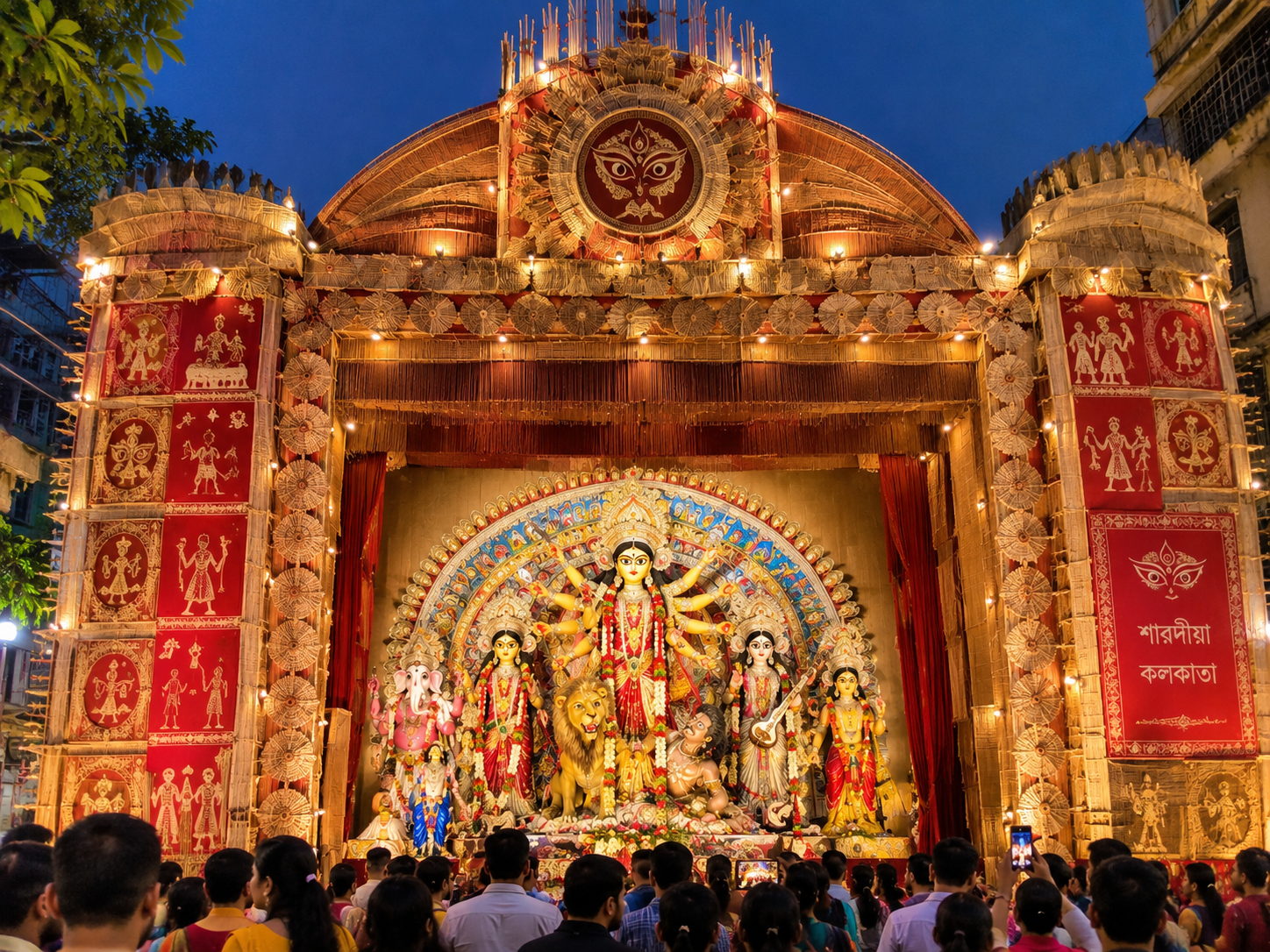
Kolkata Durga Puja 2026: From Sreebhumi Sporting Club’s Hawa Mahal-inspired pandal to Suruchi Sangha’s lotus concept, discover the famous pandals, creative themes and cultural attractions making this year’s celebrations special.
Introduction: When Kolkata Becomes a City of Art
Every year, as Durga Puja approaches, Kolkata transforms into something extraordinary. Streets glow with colourful lights, neighbourhoods fill with the sound of dhak, and enormous artistic structures appear across the city. For millions of people, Durga Puja is much more than a religious festival. It is an emotion, a tradition, a celebration of creativity and a reunion of families and friends.
In 2026, Kolkata’s famous Durga Puja pandals are once again attracting attention for their imaginative concepts, architectural inspirations and artistic interpretations of Indian culture. From grand recreations of famous landmarks to designs rooted in Bengal’s folk heritage, the festival demonstrates how traditional worship and contemporary creativity can come together.
What makes Kolkata’s celebrations particularly fascinating is that no two pandals need to tell the same story. One committee might create a visually spectacular palace-inspired structure, while another might use a simple natural object to communicate a deeper cultural or spiritual message.
The 2026 season has also drawn attention because of changing political symbolism around some traditional celebrations and a citywide beautification drive. Reports have highlighted colourful road decorations, traditional alpona artwork and the preparations surrounding the festival. An Indian Express report published on October 13 described how roads, crossings and bridges were being decorated in vivid colours.
Here is a closer look at some of the most talked-about pandals and the reasons Kolkata’s Durga Puja continues to attract visitors, photographers and audiences online.
1. Sreebhumi Sporting Club: The Hawa Mahal Experience
One of the prominent attractions highlighted in 2026 pandal coverage is Sreebhumi Sporting Club in Lake Town, known for its ambitious architectural concepts and large-scale installations.
This year’s reported theme draws inspiration from Jaipur’s famous Hawa Mahal, a historic palace recognised for its distinctive pink façade and honeycomb-like arrangement of windows. The architectural design offers a striking visual reference for a Durga Puja pandal.
The appeal of a monument-inspired pandal lies in the way it brings a famous architectural identity into a temporary festival setting. Visitors can experience the impression of a historic landmark without travelling outside Kolkata. The structure also creates opportunities for photography, videos and wide-angle shots that capture the scale of the installation.
The challenge for the artists is to translate the character of a permanent monument into a temporary structure suitable for a religious celebration. The proportions, decorative details, colours and entrance design all contribute to the final experience.
Sreebhumi has developed a reputation for attracting considerable attention with ambitious themes. However, the popularity of any individual pandal can vary by year, and its exact online ranking should not be assumed without current engagement data.
For visitors interested in architectural spectacle, Sreebhumi is a notable name to include in a Kolkata Puja itinerary.
2. Suruchi Sangha: Celebrating the Beauty of the Lotus
Suruchi Sangha in New Alipore is another well-known name in Kolkata’s Durga Puja landscape. Its 2026 theme has been reported as a celebration of the lotus, a flower associated with beauty, purity and spiritual symbolism in Indian traditions.
The lotus is a particularly effective artistic subject because its natural form combines simplicity with visual complexity. Its layered petals, balanced proportions and gradual opening create many possibilities for decoration, sculpture and lighting.
An installation based on this flower can create a visual journey from the entrance towards the central idol. Carefully arranged shapes and colours can suggest the experience of entering a giant blooming flower, making the setting feel different from a conventional architectural reproduction.
Beyond its visual qualities, the lotus carries cultural significance. It appears in Indian art, literature and religious imagery, where it is frequently associated with spiritual growth, renewal and the emergence of beauty from difficult surroundings.
This makes the concept suitable for a festival that celebrates the triumph of good over evil and the renewal of hope.
Suruchi Sangha is also recognised for its community participation and artistic presentation. Its location in New Alipore makes it a familiar destination for people exploring the southern parts of the city.
For anyone interested in a theme that connects natural beauty with cultural meaning, Suruchi Sangha deserves attention.
3. Chetla Agrani: The Colours and Traditions of Bengal
While monument-inspired structures often attract attention through their scale, Chetla Agrani offers a different artistic direction.
Coverage of the 2026 season has highlighted a theme celebrating Bengal’s folk culture and traditional craftsmanship. Reported elements include references to pattachitra, terracotta and rural artistic traditions.
These art forms represent a rich heritage passed down through generations. Pattachitra is known for its narrative paintings and distinctive decorative patterns, while terracotta reflects the use of fired clay in sculpture, architecture and ornamental work.
Bringing such traditions into a contemporary pandal can help introduce visitors to artistic practices that might otherwise receive less attention in everyday urban life.
The attraction is not simply the appearance of the structure. It is also the story behind the objects, patterns and techniques used to create it. A carefully designed installation can remind visitors that Bengal’s cultural identity extends far beyond its largest cities.
For young visitors and people discovering Kolkata’s festival for the first time, a folk-art-inspired pandal can be particularly educational. It demonstrates that innovation does not always require futuristic materials or international architectural references. Sometimes, the most powerful ideas come from local history and traditional craftsmanship.
Chetla Agrani therefore represents an important aspect of Kolkata’s Puja culture: the ability to reinterpret regional heritage for a modern audience.
4. Tridhara Sammilani: Creativity in South Kolkata
Tridhara Sammilani is a recognised Durga Puja destination in the Kalighat area. It is one of the names visitors commonly encounter when exploring the southern part of the city.
The wider appeal of established community pujas comes from their ability to combine the devotional centre of the celebration with an immersive artistic environment. The entrance, decorative details, lighting and placement of the idol all contribute to how visitors experience the pandal.
Tridhara’s place in Kolkata’s Puja culture also illustrates how the festival is shaped by neighbourhood communities. Organisers, volunteers, artists and local residents contribute to a collective project that takes months of preparation.
A pandal’s impact is not determined by its physical size alone. The balance between the theme, the artistic execution and the atmosphere can be equally important.
For visitors planning to explore several pandals in one evening, Tridhara Sammilani can form part of a south Kolkata route alongside other established destinations.
Its current theme and specific attractions should be checked against the organisers’ latest announcements before being described in a year-specific news report.
5. Mudiali Club: A Familiar Name for Puja Enthusiasts
Mudiali Club, located near Kalighat, is another prominent name in south Kolkata’s Durga Puja circuit.
The club’s long-standing presence in the city’s festival culture makes it relevant to people who enjoy exploring different interpretations of the Durga Puja experience.
One of the special qualities of Kolkata’s community pujas is the variety of artistic approaches available within a relatively compact urban area. Visitors may encounter a highly elaborate installation at one stop, a more traditional presentation at another, and a concept centred on local culture somewhere else.
This variety encourages people to look beyond a single famous attraction. A memorable Puja outing can come from discovering a smaller detail, meeting local volunteers or observing the way a neighbourhood participates in the celebration.
Mudiali can be included in a south Kolkata itinerary, particularly for visitors who want to experience more than just the largest headline-making installations.
As with every pandal, the specific design and visitor arrangements may change from season to season.
6. College Square: The Attraction of Tradition and Reflection
College Square is among Kolkata’s familiar Durga Puja destinations, located in the city’s educational and cultural district.
Its surroundings give it a different character from pandals located within large residential neighbourhoods. The wider College Street area is associated with books, educational institutions, historic establishments and intellectual life.
This setting adds another dimension to a Puja visit. Visitors can experience the festival while exploring an area that plays a significant role in Kolkata’s cultural identity.
College Square is a useful reminder that the city’s famous pandals do not all need to rely on the same kind of spectacle. The relationship between the installation and its surroundings also contributes to the overall experience.
For photography enthusiasts, the surrounding streets and the contrast between the festival decorations and the everyday urban environment can provide interesting compositions.
Visitors should check current access arrangements and crowd conditions before planning their trip, especially during peak festival hours.
7. Ekdalia Evergreen: A Landmark in Kolkata’s Puja Culture
Ekdalia Evergreen Club in Ballygunge is another established name in the city’s Durga Puja tradition.
For many festival enthusiasts, well-known community pujas are important because they connect the present celebration with years of shared memories. Families may return to the same destinations across multiple seasons, comparing the artwork, decorations and atmosphere.
Ekdalia Evergreen forms part of this continuing tradition. Its name appears regularly in discussions of established Kolkata pandals, making it relevant to anyone compiling a guide to the city’s major festival attractions.
The experience of visiting a traditional community puja differs from seeing a monument replica or a highly conceptual installation. The emotional connection may come from familiarity, ritual, the idol’s presentation and the collective participation of the surrounding neighbourhood.
That continuity is an important part of what makes Kolkata’s Durga Puja distinctive.
For a complete picture of the city, visitors should consider combining established destinations with pandals presenting new ideas rather than focusing exclusively on whichever structure receives the most social-media attention.
8. The Broader Trend: Themes That Tell a Story
One of the most interesting features of contemporary Kolkata Durga Puja is the evolution of the pandal theme.
In earlier generations, visitors might have focused primarily on the idol, the decorative entrance and the overall beauty of the structure. Today, many committees also build a narrative around the installation.
The theme might draw from architecture, literature, rural life, environmental awareness, historical events or traditional art. These approaches allow artists to communicate ideas through materials, colour, shape and space.
A successful theme can work on several levels. It can look impressive in person, communicate a recognisable idea to visitors and remain meaningful when photographed or filmed.
The strongest installations often invite visitors to pause and consider what they are seeing rather than simply walk through the entrance and leave.
This approach also helps explain why Durga Puja attracts interest beyond West Bengal. Visitors encounter not only religious imagery but also a large public exhibition of design and craftsmanship.
Nevertheless, a theme’s popularity should not be confused with a verified viral ranking. Online attention changes rapidly, and a video that attracts millions of views may not reflect the number of people visiting the pandal in person.
9. Why Kolkata’s Pandals Attract Attention Online
Social media has changed the way people discover Durga Puja attractions.
Short videos can show the entrance of a pandal, reveal the central idol, capture the lighting and provide a quick impression of the crowd. A dramatic architectural design may be shared widely because it is visually recognisable even to viewers who have never visited Kolkata.
Photography and video also encourage visitors to compare different artistic concepts. One person might prefer an elaborate palace-inspired installation, while another might be more interested in folk art or traditional idol-making.
However, online visibility depends on more than artistic quality. Posting time, video editing, audience interests, sound selection and the reach of the account sharing the content can all influence engagement.
There is no single reliable way to declare one pandal the most viral without specifying the platform, measurement and time period.
For a responsible news article, terms such as “one of the most talked-about pandals” or “a notable attraction of the 2026 season” are preferable unless a ranking is supported by current data.
10. Beyond the Pandal: Kolkata’s Festive Transformation
The festival’s impact extends well beyond the temporary structures themselves.
Kolkata’s roads, crossings, bridges and neighbourhoods become part of the visual celebration. An Indian Express report dated October 13, 2026, described a beautification drive involving bright colours and traditional alpona artwork at prominent locations, including Park Circus and Gariahat.
Alpona is a traditional decorative art associated with Bengal, often created using white rice-flour designs. Its presence in public spaces connects familiar artistic practices with the larger festival environment.
These decorations contribute to the feeling that the entire city participates in Puja. Even people who do not visit every major pandal can encounter the celebrations through illuminated streets, community gatherings and local decorations.
The festival also brings together artists, artisans, organisers, volunteers, local businesses and visitors. Behind every elaborate installation is a large amount of planning, material preparation and coordinated work.
This collective effort is one reason Durga Puja is so important to Kolkata’s cultural and social life.
11. How to Explore Kolkata’s Famous Pandals
Anyone planning a pandal visit should begin by choosing a manageable group of destinations rather than trying to cover the entire city in one outing.
South Kolkata visitors can consider a route featuring Suruchi Sangha, Chetla Agrani, Tridhara Sammilani, Mudiali Club and Ekdalia Evergreen. Sreebhumi Sporting Club is in the Lake Town area, so it is more practical to visit it as part of a separate northern or northeastern Kolkata route.
Crowds and traffic can change substantially during the festival. Visitors should check local travel updates, follow organiser instructions and allow extra time between stops.
Families travelling with children or older relatives should plan for rest breaks and avoid pushing through dense crowds. Following official crowd-control arrangements helps protect visitors and allows everyone to enjoy the celebration more comfortably.
Photography should also be approached respectfully. Visitors should follow restrictions announced by organisers and avoid blocking entrances or pathways while recording videos.
The goal is to enjoy the art and atmosphere while respecting the religious and community significance of the event.
Conclusion: The Magic of Durga Puja Lives Beyond the Decorations
Kolkata’s Durga Puja is extraordinary because it brings many different forms of creativity together in a single celebration. A monument-inspired pandal, a lotus-themed installation and a tribute to Bengal’s folk heritage may look completely different, yet each can contribute to the same larger cultural experience.
Sreebhumi Sporting Club, Suruchi Sangha and Chetla Agrani illustrate the variety of concepts highlighted in coverage of the 2026 season. Established destinations such as Tridhara Sammilani, Mudiali Club, College Square and Ekdalia Evergreen add further depth to a citywide tradition built on community participation and artistic expression.
The real appeal of these pandals is not simply whether they become viral online. It is the way they bring people together, introduce visitors to new artistic ideas and preserve the spirit of a festival that remains deeply connected to Kolkata’s identity.
Every year, the city offers new reasons to look, learn, photograph and celebrate. The decorations may be temporary, but the memories created by the festival can last much longer.
For Kolkata, Durga Puja is not merely an event on the calendar. It is a living expression of faith, art, culture and community—one that continues to make the city stand out on India’s cultural map.


Leave a Reply