INDIA Bloc Rally 2026: Latest Delhi Protest Updates
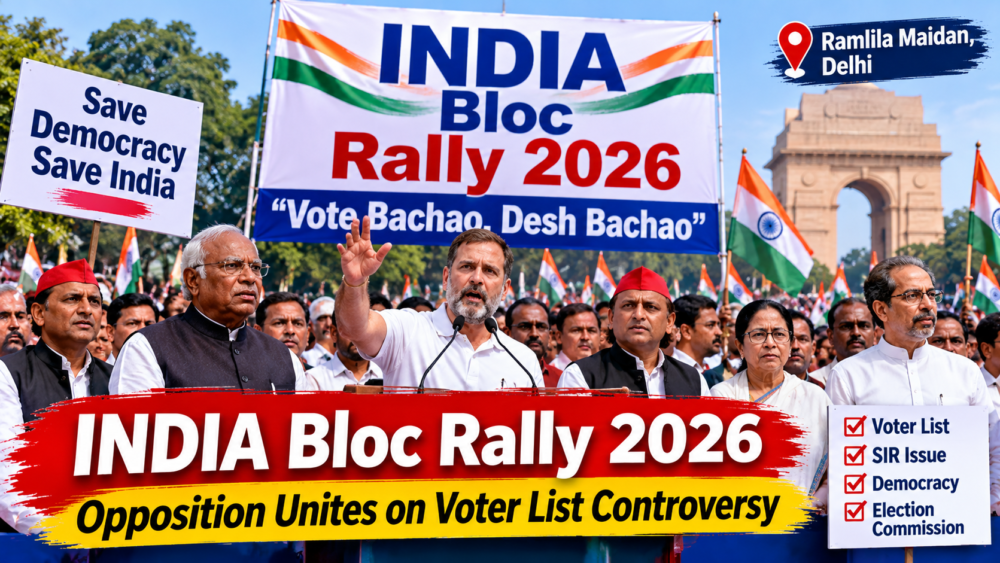
INDIA Bloc Rally 2026: Thousands Gather at Delhi’s Ramlila Maidan Over Voter List Controversy
Introduction
Indian politics witnessed a major development on November 1, 2026, as opposition parties under the INDIA bloc gathered in New Delhi for a large political demonstration at Ramlila Maidan. The rally, organised under the message “Vote Bachao, Desh Bachao”, focused on concerns surrounding electoral transparency, voter-list revisions and the functioning of India’s Election Commission.
The demonstration brought together opposition leaders, party workers, students and supporters from different parts of the country. Thousands of people participated in the protest, making it an important political event in the national conversation.
The rally was organised amid growing political disagreement over the Special Intensive Revision (SIR) of electoral rolls. Opposition parties have alleged that the voter-list revision process could result in eligible citizens losing their voting rights. They have also demanded accountability from Chief Election Commissioner Gyanesh Kumar.
The Election Commission, meanwhile, has defended the legality of its procedures and maintained that its decisions follow established rules.
The INDIA bloc rally 2026 has therefore become more than a political gathering. It has brought renewed attention to questions about democratic participation, electoral transparency and the importance of protecting every eligible citizen’s right to vote.
1. What Is the INDIA Bloc Rally 2026?
The INDIA bloc rally is a major opposition demonstration organised in New Delhi on November 1, 2026.
The gathering took place at the historic Ramlila Maidan, a location that has hosted several important political demonstrations and public movements in India.
The event was organised as part of the opposition alliance’s campaign against alleged irregularities in electoral-roll revisions and concerns regarding the Election Commission.
The main campaign slogan was “Vote Bachao, Desh Bachao”, which translates to “Save the Vote, Save the Nation”.
Opposition leaders used the rally to communicate their concerns about voter registration, electoral procedures and democratic accountability.
The event also provided an opportunity for different opposition parties to demonstrate their collective political position on an issue they consider important for India’s democratic institutions.
2. Why Did the INDIA Bloc Organise the Rally?
The main reason behind the demonstration is the controversy surrounding the Special Intensive Revision of voter lists.
Electoral rolls are official records containing the names of citizens eligible to vote in elections. Maintaining accurate voter lists is essential because these records determine who can participate in the democratic process.
The Election Commission periodically undertakes revision exercises to update voter information, remove duplicate or ineligible entries and include newly eligible voters.
However, the current revision process has become a subject of political disagreement.
Opposition parties have raised concerns about the possibility of eligible voters being removed incorrectly from electoral rolls. They argue that voters must have a transparent process through which they can check their registration status and correct mistakes.
The INDIA bloc believes that electoral procedures should be transparent, accessible and fair to every citizen.
The Election Commission has rejected allegations of political bias and maintained that electoral-roll procedures are governed by legal and administrative rules.
These competing positions have made the issue a significant subject of national political debate.
3. What Is the Special Intensive Revision (SIR)?
The Special Intensive Revision, commonly known as SIR, is an exercise undertaken to review and update electoral rolls.
Its purpose is to improve the accuracy of voter registration records.
During such exercises, election authorities review voter information and verify eligibility. The process can involve checking residential details, identifying duplicate registrations and updating records when people move or become newly eligible to vote.
Although voter-list revision is an important administrative responsibility, it must be carried out carefully.
Incorrect removal of a registered voter can create serious difficulties, especially if the affected individual is unable to correct the record before an election.
This is why transparency, public communication and accessible correction procedures are important.
The opposition has questioned aspects of the current SIR process, while the Election Commission maintains that its procedures have legal backing.
For ordinary citizens, the most important point is to check their voter registration information and understand the official process for correcting any mistakes.
4. Rahul Gandhi and Other Opposition Leaders Raise Their Voices
Congress leader Rahul Gandhi has been one of the prominent political figures associated with the INDIA bloc’s campaign.
Ahead of the demonstration, he appealed to citizens, students and young people to participate in the march and support the campaign for electoral transparency.
Congress president Mallikarjun Kharge and other senior opposition leaders were also associated with the mobilisation.
The rally brought together representatives and supporters from different opposition parties.
The participation of multiple political groups highlighted the alliance’s attempt to present a united position on electoral issues.
For the opposition, the rally was an opportunity to attract national attention to its concerns and demand greater accountability from electoral authorities.
The participation of different leaders also demonstrated how electoral procedures have become an important subject of political discussion beyond individual party interests.
5. March From Minto Road to Ramlila Maidan
One of the major features of the INDIA bloc rally was the planned march through central Delhi.
The mobilisation was scheduled to begin near the Minto Road–Connaught Place junction before proceeding towards Ramlila Maidan.
The march was planned for noon, followed by the main rally at the venue.
The route attracted attention because it connected an important commercial and public area of the capital with a historic political gathering place.
Leaders were also expected to travel in open buses before joining the demonstration.
The march and rally were designed to create public awareness about the opposition’s concerns surrounding voter-list revisions and electoral transparency.
Delhi Police made extensive security and traffic arrangements to manage the gathering and minimise disruption to the public.
6. Security Arrangements and Traffic Restrictions in Delhi
A large political gathering in the national capital requires significant planning and coordination.
Authorities arranged additional security personnel, CCTV surveillance and crowd-management measures for the November 1 demonstration.
Reports indicated that more than 4,000 police personnel and Central Armed Police Forces personnel were deployed for security arrangements.
Ramlila Maidan was divided into multiple security zones, with surveillance cameras and monitoring systems installed around the venue.
Traffic restrictions and diversions were also planned across several central Delhi roads.
Areas around ITO, Delhi Gate, Rajghat, Ajmeri Gate and Turkman Gate were among the locations affected by traffic-management arrangements.
Such measures are important during large public events because they help maintain public safety and allow emergency services to operate.
Residents, commuters, visitors and business owners were advised to consider traffic diversions while travelling through the affected areas.
7. Why Are Voter Lists Important for Indian Democracy?
Voting is one of the most important rights in a democratic country.
Through elections, citizens choose representatives who make decisions on public policy, economic development, education, healthcare and other important issues.
However, the right to vote can only be exercised effectively when eligible citizens are correctly registered.
An accurate electoral roll helps ensure that eligible voters can participate in elections without unnecessary difficulties.
If a person’s name is missing from the voter list, that individual may face problems when attempting to vote.
This makes the accuracy of voter registration records extremely important.
Political disagreements over voter lists also demonstrate why electoral institutions need public confidence.
Regardless of political affiliation, citizens should be able to access reliable information, understand registration procedures and receive opportunities to correct errors.
The debate surrounding SIR has therefore created an important discussion about the relationship between administrative efficiency and democratic participation.
8. Election Commission’s Position and the Political Disagreement
The Election Commission of India plays a central role in organising and supervising elections.
Its responsibilities include maintaining electoral rolls, conducting elections and ensuring that electoral procedures follow the law.
The opposition has raised questions about the SIR process and demanded greater accountability from Chief Election Commissioner Gyanesh Kumar.
The alliance has also demanded his resignation.
However, the Election Commission has defended its procedures and stated that its decisions have the necessary legal backing.
This disagreement highlights an important difference between political criticism and institutional responsibility.
Political parties have the right to raise concerns and demand explanations. At the same time, electoral authorities are responsible for implementing the law and maintaining accurate voter records.
Any specific allegation of wrongdoing must be examined through credible evidence and appropriate legal or administrative processes.
A healthy democracy requires transparent communication between public institutions, political representatives and citizens.
9. Traders Express Concerns About Business Disruption
The rally also generated discussion among traders and business organisations in central Delhi.
The Chamber of Trade and Industry reportedly raised concerns about possible disruption to commercial activities because of traffic restrictions and the expected crowd.
According to reports, the organisation estimated that business worth approximately Rs 10,000–12,000 crore across nearly 20 major markets could be affected.
The traders’ body suggested postponing the rally until after Diwali or shifting the venue to another location.
These concerns reflect the challenges that large public events can create for commercial areas.
Traffic restrictions, limited vehicle access and crowd movement can affect customers, delivery services and shop operations.
At the same time, peaceful public demonstrations are an important part of democratic participation.
The challenge for authorities and organisers is to balance public protest with the everyday needs of residents and businesses.
10. What Does the Rally Mean for the INDIA Bloc?
The rally represents an important opportunity for the INDIA bloc to demonstrate political unity.
The opposition alliance consists of several parties with different regional strengths, political priorities and organisational structures.
Bringing these groups together around a common issue can help the alliance communicate a shared message.
Electoral transparency is a subject that allows opposition parties to focus on democratic institutions rather than individual political differences.
However, maintaining unity over the long term can be challenging.
Different parties may have different strategies, regional interests and electoral priorities.
The success of the alliance will depend on its ability to maintain coordination, communicate clear demands and present credible alternatives on issues affecting citizens.
The rally may therefore influence future opposition campaigns and political discussions.
11. How Could the Controversy Affect Ordinary Citizens?
The voter-list controversy is not limited to political parties or government institutions.
It can directly affect ordinary citizens.
People who move to a different city, change their residential address or have errors in their voter information may need to update their registration details.
For this reason, citizens should regularly check their electoral information through official Election Commission services.
If a person’s name is missing or incorrect, they should follow the prescribed procedure for correction or registration.
Students, first-time voters, migrant workers and people who have recently changed their residence should pay particular attention to their registration status.
It is also important to avoid relying on unverified social media posts about voter registration.
Official information should always be preferred when checking eligibility, registration deadlines and correction procedures.
12. What Happens Next After the INDIA Bloc Rally?
The November 1 rally is likely to keep electoral transparency and voter-list revisions in the national political discussion.
The opposition may continue to demand explanations and changes to procedures that it believes could affect eligible voters.
The Election Commission may also face continued questions from political representatives and other stakeholders.
The next stage of the debate will depend on official responses, administrative decisions and any legal proceedings connected with specific allegations.
Political rallies can attract public attention, but long-term changes generally require institutional discussions, legal procedures and evidence-based action.
Citizens should follow verified updates rather than assuming that every demand made during a demonstration will automatically become government policy.
The issue is likely to remain relevant as India continues discussions about electoral reforms and democratic accountability.
13. Why Is Electoral Transparency Important for India’s Future?
India is the world’s largest democracy, with a huge and diverse electorate.
Managing elections across different states, languages, communities and geographical regions requires a reliable administrative system.
Electoral transparency helps build trust between citizens and democratic institutions.
When people understand how voter registration works and how errors can be corrected, they are more likely to participate confidently in elections.
Transparent procedures also help reduce confusion and political disagreement.
Technology can support this process through digital voter services, accessible information and better record management.
However, digital systems must also be accurate, secure and accessible to people who may not have reliable internet access.
Ultimately, democratic confidence depends on both efficient administration and public trust.
The INDIA bloc rally has brought these questions back into the national conversation.
Conclusion
The INDIA bloc rally 2026 at Delhi’s Ramlila Maidan has become an important political event because of the wider debate surrounding voter-list revisions, the Special Intensive Revision process and electoral transparency.
Thousands of people joined the demonstration, while opposition leaders used the platform to raise concerns about democratic participation and demand accountability from the Election Commission.
The controversy also highlights the importance of accurate voter registration and accessible procedures for correcting errors.
At the same time, the Election Commission’s position and the need for evidence-based examination of political allegations remain important parts of the discussion.
For ordinary citizens, the biggest lesson is to stay informed, verify voter registration details through official channels and understand the democratic processes that protect their right to participate.
India’s democracy depends not only on political leaders and institutions but also on informed and active citizens.
Stay connected with IndiaHandle.com for more Indian political news, current affairs, business updates and important national developments.

Leave a Reply