Why Indian Traditions Still Matter in the Age of Social Media
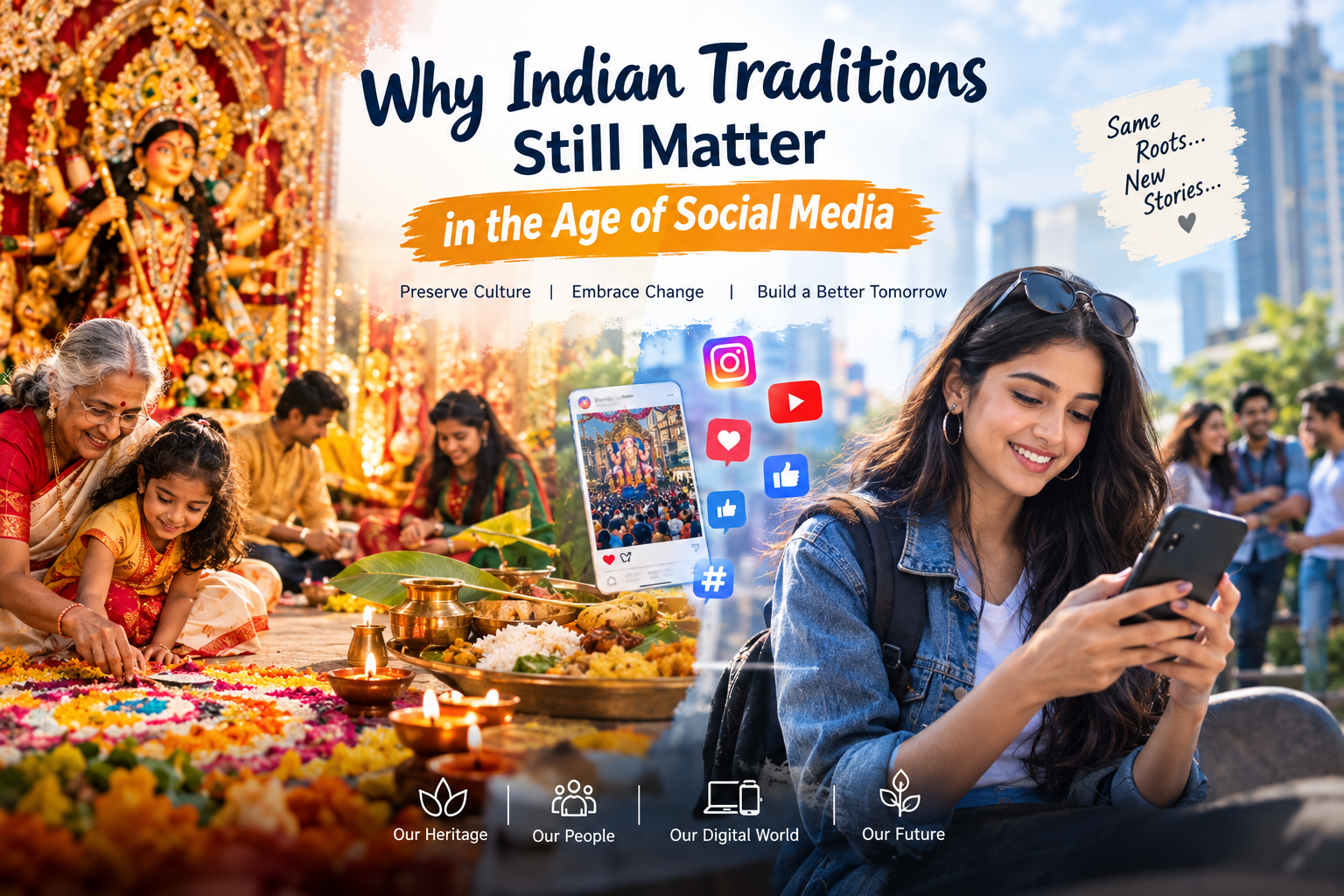
Why Indian Traditions Still Matter in the Age of Social Media
India is a country where ancient traditions meet modern ambitions every day. A young person might begin the morning by touching their grandparents’ feet, spend the afternoon working on a digital platform, and end the evening sharing a photograph on Instagram. A family might follow a traditional festival ritual while using online shopping to prepare for the celebration. These everyday moments reveal something important: modern lifestyles and Indian traditions do not always compete with each other. Often, they exist side by side.
Yet, as social media becomes a bigger part of everyday life, an important question emerges: Are Indian traditions still meaningful to the younger generation, or are they slowly becoming content for likes, views, and viral trends?
The answer is more complicated than it appears. Technology has changed how people discover, practise, and share their culture. Some traditions are gaining fresh attention, while others risk being forgotten. Understanding this change is essential because traditions are not merely customs inherited from the past. They can also connect families, preserve regional identities, teach valuable lessons, and give people a sense of belonging in a rapidly changing world.
1. What Makes Indian Traditions So Important?
Indian traditions reflect centuries of history, cultural exchange, religious beliefs, regional customs, and community experiences. They can be seen in festivals, food, clothing, music, languages, family practices, art, and everyday expressions of respect.
From lighting diyas during Diwali to celebrating Durga Puja, preparing traditional dishes during Eid, performing folk dances during regional festivals, or gathering with family during important occasions, these practices give people opportunities to connect with their cultural roots.
Traditions also carry knowledge from one generation to another. A grandmother teaching a grandchild a family recipe passes on more than cooking instructions. The experience may include memories of childhood, regional ingredients, family stories, and techniques developed over many years.
Similarly, traditional crafts preserve the skills of artisans, while folk songs and oral storytelling help communities remember their histories.
Not every tradition has the same meaning for every individual, and customs naturally change over time. Nevertheless, traditions can offer continuity in a world where careers, cities, technologies, and lifestyles change rapidly.
For many people, cultural practices provide a connection to their families and communities even when they live far from their hometowns.
Traditions matter not because everything from the past must remain unchanged, but because understanding our heritage helps us decide what deserves to be carried into the future.
2. How Social Media Is Changing Indian Culture
Social media has transformed the way people experience culture. In the past, learning about a regional custom often depended on family members, local communities, books, or personal travel. Today, a short video can introduce viewers to a festival, traditional dance, craft technique, or regional dish from another part of India.
A creator from Assam can showcase Bihu celebrations to viewers in Maharashtra. An artisan from Rajasthan can demonstrate traditional block printing to an international audience. A young cook can share a family recipe with people who have never visited the region where it originated.
This increased visibility can help cultural practices reach new audiences.
Social media also gives younger generations opportunities to explore traditions independently. Someone who has moved to another city for education or work can use online resources to learn traditional recipes, understand the meaning of festivals, or participate in virtual cultural communities.
However, online visibility does not always mean deeper cultural understanding.
A video may show a beautiful ritual without explaining its history. A traditional outfit may become fashionable while the craftsmanship behind it receives little attention. A regional dance might go viral because of a short music clip, while viewers remain unfamiliar with its cultural context.
The challenge is to move beyond simply watching cultural content and develop a genuine interest in the people, stories, and skills behind it.
Social media can open the door to cultural learning, but meaningful understanding requires curiosity beyond the screen.
3. Are Young Indians Moving Away from Tradition?
The relationship between Indian youth and tradition is often described in overly simple terms. Older generations may worry that young people are becoming too influenced by global trends, while younger people may feel that traditional expectations do not always reflect their modern lives.
In reality, many young Indians are finding new ways to connect with their heritage.
Some wear traditional clothing at college festivals and family gatherings. Others learn classical music, practise regional dances, explore Indian languages, or support independent artists who preserve cultural forms. Many young creators use digital platforms to explain traditional customs in a language that their peers understand.
At the same time, modern education, migration, busy schedules, and changing family structures can reduce opportunities to learn certain practices at home.
A young adult living away from their family may not know how to prepare a traditional dish. Someone raised in a different linguistic environment may understand their ancestral language only partially. Another person may participate in festivals without knowing the stories associated with them.
These situations do not necessarily indicate a lack of cultural pride. They may reflect limited exposure or changing circumstances.
The solution is not to criticise young people for living differently. Instead, families and communities can create opportunities for cultural learning that feel relevant and welcoming.
Traditions are more likely to survive when younger generations understand their meaning and can participate willingly, rather than feeling that culture is simply a list of rules they must follow.
4. Indian Festivals: Where Tradition Meets Modern Trends
Indian festivals provide some of the clearest examples of how culture evolves.
During Diwali, families may decorate their homes with diyas and rangoli while also sharing photographs and videos online. During Durga Puja, elaborate pandals, artistic installations, cultural programmes, and community gatherings attract visitors who discover the celebrations through social media. Holi celebrations may combine traditional customs with contemporary music and organised events.
These changes can make festivals more accessible and creative. Digital platforms help communities share information about local celebrations, while online fundraising and promotion can support cultural organisations and artisans.
However, festivals can also become overly focused on appearances.
People may feel pressure to buy new outfits, arrange expensive decorations, or create picture-perfect celebrations. In some cases, documenting an event becomes more important than participating in it.
Commercial promotions can further encourage the idea that a successful festival requires new purchases and elaborate arrangements.
Yet, the emotional value of a festival does not depend on its budget. A modest family gathering, a shared meal, a visit to an elderly relative, or helping someone in need can express the spirit of a celebration more meaningfully than an expensive display.
Modern trends can refresh festivals, but they should not determine the entire purpose of celebrating them.
5. Family Values in a Fast-Changing Society
Family traditions remain an important part of Indian cultural life, although family structures and expectations continue to change.
For many households, practices such as sharing meals, celebrating birthdays together, visiting relatives, caring for older family members, and gathering during festivals create opportunities for emotional connection.
These activities can help children develop a sense of family history and understand the experiences of previous generations.
However, modern life often makes these interactions more difficult. Work schedules, academic pressure, migration, and digital distractions can reduce the time families spend together.
Technology can help families remain connected across distances, but constant digital activity can also interrupt face-to-face conversations.
The goal should not be to reject technology. Instead, families can create simple habits that protect time for meaningful interaction.
They might prepare a traditional meal together, ask older relatives to share childhood memories, celebrate important occasions through video calls, or spend part of a festival without phones.
Family values also deserve thoughtful interpretation. Respect, kindness, responsibility, and mutual support can strengthen relationships, but cultural expectations should not be used to justify discrimination, coercion, or unequal treatment.
Preserving the positive aspects of family tradition means carrying forward values that help people care for one another while allowing individuals the freedom to make their own choices.
6. Traditional Art, Clothing, and Crafts Need Modern Support
India’s cultural heritage includes a wide range of artistic traditions, from handloom weaving and embroidery to pottery, woodwork, folk painting, music, dance, and theatre.
These practices are not simply decorative elements of the past. They represent specialised skills, regional knowledge, and the livelihoods of artisans and performers.
Modern markets can create opportunities for traditional crafts to reach new customers. Social media allows artists to display their work, explain their methods, and communicate directly with potential buyers. Online marketplaces can help small producers reach customers beyond their local areas.
Young designers can also introduce traditional fabrics, patterns, and techniques into contemporary clothing.
But there is a difference between appreciating traditional art and using it merely as a trend.
When buyers focus only on low prices, artisans may struggle to earn a sustainable income. When designs are copied without acknowledging their origins, the communities that developed them may receive little recognition. When a craft is valued only because it becomes fashionable online, interest can disappear as quickly as it arrived.
Consumers can support cultural preservation by learning about the products they purchase, choosing authentic work where possible, and recognising the people behind traditional crafts.
Schools, cultural organisations, designers, and businesses can contribute by creating opportunities for artisans to teach their skills and reach wider audiences.
Keeping traditional art alive requires more than admiration. It requires respect, recognition, and sustainable livelihoods.
7. Can Modern Technology Help Preserve Indian Traditions?
Technology is often blamed for weakening cultural connections, but it can also become a powerful tool for preservation.
Digital archives can record folk songs, local histories, traditional recipes, and oral stories before they disappear from everyday practice. Educational videos can explain regional customs, while online communities can connect people who share an interest in particular languages, crafts, or art forms.
Families can record elders telling stories about their childhood, hometowns, and traditional celebrations. Young people can document local festivals and interview artisans about their work. Schools can create digital projects exploring the history of their regions.
These efforts can help preserve knowledge that might otherwise remain within a small community.
Artificial intelligence and digital translation tools may also help people explore unfamiliar languages and historical material. However, such tools should be used carefully because cultural details can be misinterpreted, simplified, or presented inaccurately.
Digital preservation works best when communities themselves participate in deciding what is recorded, how it is explained, and who can access it.
Technology should support cultural knowledge rather than replace the people who carry it.
8. Tradition Should Evolve, Not Become a Burden
One important question is often overlooked in discussions about cultural preservation: should every tradition continue exactly as it was practised in the past?
The answer is no.
Cultures have always evolved through migration, trade, social reform, technological change, and interaction between communities. Food, clothing, music, celebrations, and family practices have changed throughout Indian history.
Some customs may remain meaningful across generations. Others may need reinterpretation, while certain practices should be reconsidered when they cause harm or deny people equal dignity.
Preserving culture does not require accepting every inherited belief without question.
For example, traditional celebrations can become more environmentally responsible. Family practices can become more inclusive. Cultural education can encourage equal participation and respect for different backgrounds.
The purpose is not to erase the past, but to understand it honestly and carry forward what contributes to a better society.
Young people should have the freedom to question traditions respectfully, just as older generations should have opportunities to share the experiences behind them.
A living culture makes room for conversation, learning, and change.
9. Practical Ways to Keep Indian Traditions Alive
Preserving culture does not require expensive programmes or major commitments. Small, consistent actions can make a meaningful difference.
Learn one family tradition. Ask an older relative about a recipe, festival custom, folk song, or family story. Record the explanation with their permission.
Explore your regional heritage. Learn about the language, art, music, clothing, and celebrations associated with your hometown or ancestral community.
Support local artisans. Buy handmade products when practical, attend local cultural events, and share information about the people who create traditional art.
Celebrate with understanding. Learn why a festival is observed instead of focusing only on decorations, shopping, or photographs.
Use social media positively. Share accurate cultural information, credit artists, and encourage people to explore the history behind traditions.
Make cultural learning enjoyable for children. Cooking together, visiting museums, listening to folk stories, and participating in local celebrations can make heritage part of everyday life.
Respect cultural diversity. India contains many communities with different customs and beliefs. Learning about these differences can strengthen mutual understanding.
Adapt responsibly. Keep meaningful customs alive while finding safer, more inclusive, and environmentally responsible ways to practise them.
These actions demonstrate that cultural preservation is not solely the responsibility of historians or cultural institutions. It can begin with the choices people make at home and in their communities.
10. The Future of Indian Culture Belongs to Every Generation
The future of Indian traditions will not be decided by social media alone. It will depend on whether families share their knowledge, whether young people remain curious, whether artisans receive recognition, and whether communities create space for cultural practices to continue.
Older generations have valuable experiences and knowledge to share. Younger generations bring new tools, creative ideas, and different perspectives. When both groups learn from one another, traditions can remain relevant without losing their character.
Schools can introduce students to regional histories and artistic practices. Businesses can support traditional crafts through fair partnerships. Digital creators can make cultural learning engaging and accurate. Families can preserve memories and encourage meaningful participation.
No single approach will work for every community. Some traditions may thrive through public celebrations, while others may survive through family practices, local workshops, or digital documentation.
What matters is that culture remains connected to real people and lived experiences.
India’s heritage is strongest when it is understood as something people actively practise, question, share, and develop—not merely something displayed on special occasions.
Conclusion: Keep the Roots, Welcome the Future
Indian traditions still matter in the age of social media because they offer more than nostalgia. They can connect generations, preserve artistic knowledge, strengthen communities, and help people understand their cultural identities.
Modern technology and changing lifestyles have created new challenges, but they have also opened opportunities to introduce Indian heritage to wider audiences. The real task is to use these opportunities thoughtfully.
A traditional festival can be celebrated with modern decorations. A regional recipe can be shared through a digital video. Traditional clothing can inspire contemporary fashion. Family stories can be preserved through recordings and online archives.
None of these changes automatically weakens culture.
What matters is whether the meaning, knowledge, and people behind these traditions continue to receive attention and respect.
We do not have to choose between our roots and our future. We can carry the wisdom of the past into a changing world while making room for new ideas, fairer practices, and creative expression.
The next generation does not need to preserve every tradition exactly as it was. It needs to understand its heritage well enough to decide what should be protected, what should evolve, and what should be left behind.
Because culture remains alive not when people simply remember it, but when they find meaningful reasons to practise, share, and pass it on.

Leave a Reply