Social Media: Connecting People or Destroying Real Relationships?
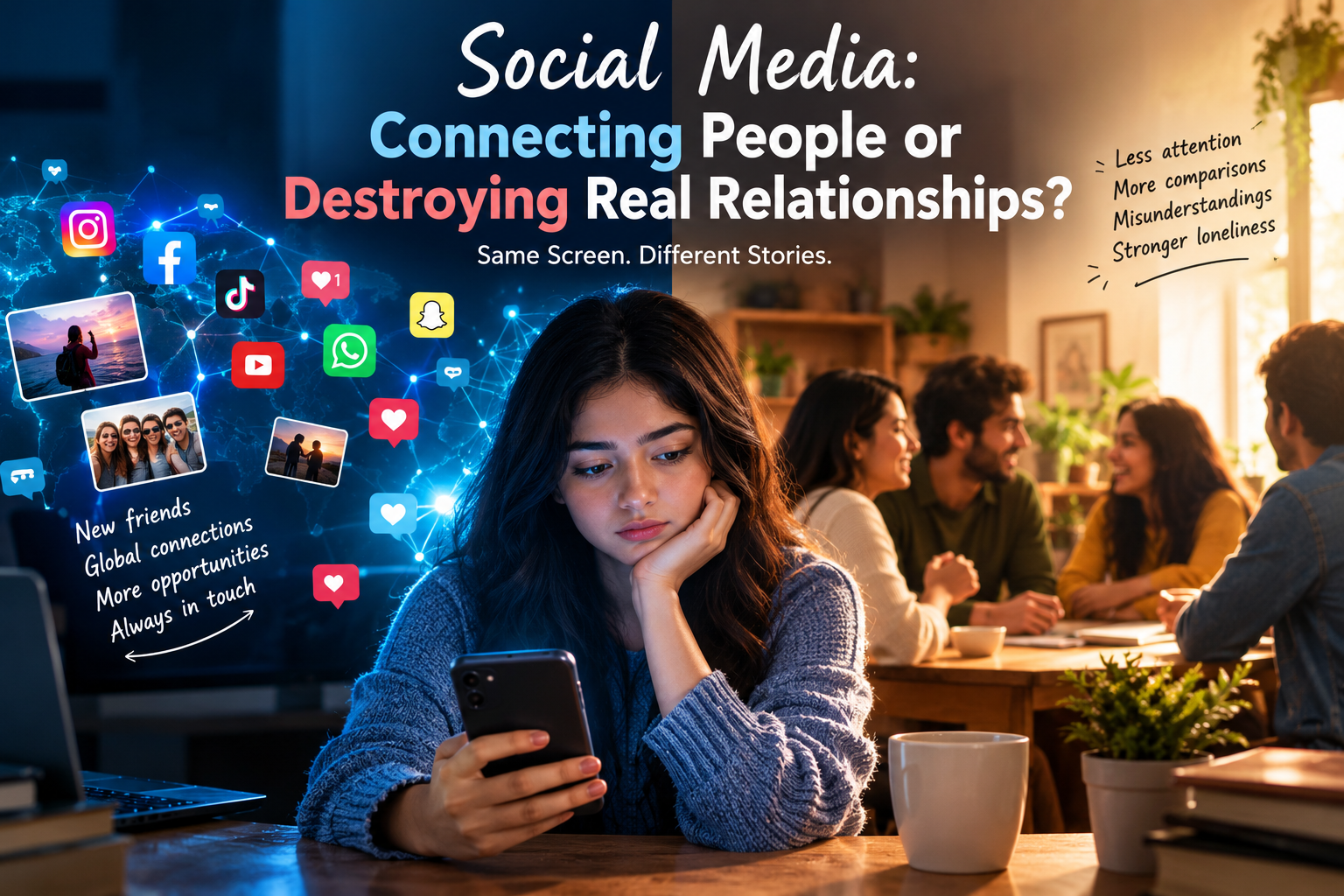
Social Media: Connecting People or Destroying Real Relationships?
How the Digital World Is Changing Human Connection, Emotional Intimacy, and the Way We Communicate
Imagine sitting at a dinner table with your family. Everyone is physically present, yet nobody is truly there. One person is scrolling through Instagram, another is watching YouTube Shorts, and someone else is replying to messages. Conversations become shorter, eye contact disappears, and the silence between notifications grows louder.
Now imagine the same family living in different cities, sharing a video call, celebrating a birthday online, and staying connected despite the distance. Suddenly, the same technology that distracted the family in one situation has brought them closer in another.
This is the paradox of social media.
Platforms such as Instagram, Facebook, WhatsApp, Snapchat, and TikTok have transformed how people communicate, maintain friendships, and build relationships. A message can cross continents in seconds, an old friendship can be revived with a single notification, and strangers can discover communities where they feel understood.
Yet, beneath this convenience lies a growing question: Are we becoming better at communicating with people while losing the ability to truly connect with them?
Social media itself is neither entirely good nor entirely harmful. Its influence depends on how we use it, why we use it, and whether our digital habits strengthen or weaken the relationships that matter most.
1. The Rise of a World That Never Stops Connecting
Human beings have always searched for ways to stay connected. Letters, telephones, and emails gradually made communication faster, but social media introduced something different: continuous connection combined with public sharing.
Today, people can share photographs, opinions, achievements, celebrations, and everyday experiences with hundreds of contacts at once. Friends separated by oceans can remain involved in one another’s lives. Families living abroad can participate in important moments through video calls. Students can collaborate, exchange ideas, and find communities beyond their immediate surroundings.
This accessibility has made social media an important part of modern relationships.
However, constant availability has also created new expectations. A message may be expected to receive an immediate response. A missed call or an unanswered text can be interpreted as a sign of disinterest. Someone who does not react to a photograph may appear less supportive than someone who leaves a comment.
Communication has become faster, but the pressure to remain available has increased.
The problem begins when connection becomes an obligation rather than a choice. Being reachable every minute does not mean being emotionally available. Sometimes, the healthiest relationship is one in which people feel secure enough to reply later without fear of being misunderstood.
2. When Digital Connections Strengthen Real Relationships
It would be unfair to describe social media only as a threat to human relationships. For many people, it is a valuable bridge between distance and belonging.
Consider a student who moves to another city for higher education. Through messages, photographs, and video calls, the student can remain part of family celebrations and everyday conversations. Grandparents can watch their grandchildren grow up, childhood friends can maintain contact, and couples in long-distance relationships can share moments that would otherwise be missed.
Social media also creates opportunities to meet people with shared interests. Someone who feels isolated because of a hobby, personal challenge, or professional ambition may find supportive communities online.
For small businesses and independent creators, digital platforms can build relationships with customers and audiences. For students, they can provide educational resources, collaboration opportunities, and access to new perspectives.
Research reviews have also found that social media’s effects on relationships can be positive or negative, depending partly on the quality and nature of online interactions. Intentional communication can support existing bonds, while excessive or unhelpful use may contribute to relational difficulties.
The important distinction is between using social media to nurture relationships and using it as a substitute for meaningful interaction.
A heartfelt message can remind someone that they are loved. A video call can make distance feel smaller. A supportive comment can encourage someone during a difficult day.
Digital communication becomes valuable when it carries genuine attention, care, and understanding.
3. The Hidden Cost of Being Always Online
If social media helps people stay connected, why do some relationships feel increasingly distant?
One explanation is that attention is limited. Every minute spent responding to online content is a minute that may not be spent listening, talking, or sharing experiences with someone nearby.
Imagine telling a friend about a difficult day while they repeatedly glance at their phone. They may hear your words, but their divided attention can leave you feeling unimportant.
This behaviour is sometimes described as phubbing—ignoring or neglecting someone in a social setting to focus on a phone.
The damage may seem minor in a single moment. However, repeated interruptions can communicate a painful message: whatever is happening on the screen matters more than the person sitting beside you.
Over time, these moments can weaken the quality of everyday interactions.
Relationships rarely depend only on grand gestures. They are often built through small experiences: listening without interruption, remembering details, noticing changes in someone’s mood, and being present when life becomes difficult.
A phone can deliver a thousand messages, but it cannot automatically provide the attention required to make another person feel understood.
The solution is not to reject technology. It is to recognise that attention is one of the most valuable things we give to other people.
4. Likes, Followers, and the Illusion of Popularity
Social media has created new ways to measure visibility. Followers, likes, comments, shares, and views can make popularity appear measurable.
But these numbers can create a misleading picture of friendship.
A person may have thousands of followers and still struggle to find someone to call during a difficult moment. Another person may rarely post online but enjoy a small circle of deeply supportive relationships.
The difference is simple: being noticed is not the same as being known.
Online platforms often reward content that attracts immediate reactions. As a result, people may feel encouraged to share the most attractive, exciting, or impressive versions of their lives.
Holidays, achievements, celebrations, and carefully selected photographs become public evidence of happiness. Ordinary struggles, misunderstandings, financial difficulties, and lonely evenings are less likely to appear in the same feed.
This creates a distorted comparison. People compare their complete lives—including their failures and uncertainties—with the carefully selected highlights of others.
A friend buying a new car may trigger feelings of inadequacy. Someone else’s holiday photographs may make an ordinary weekend seem disappointing. A celebration that receives fewer likes than expected may begin to feel less meaningful.
Such comparisons can influence confidence and relationships, especially when online popularity becomes a measure of personal worth.
A healthier approach is to remember that social media shows selected moments, not the complete reality of another person’s life.
Your value cannot be accurately measured by an algorithm, a follower count, or the number of people who react to your latest photograph.
5. How Social Media Can Create Jealousy and Distrust
Trust is essential to healthy relationships, but social media can introduce new reasons for suspicion.
A partner may wonder why someone liked a particular photograph. A delayed reply may lead to assumptions. An unfamiliar follower, a hidden notification, or an online status can become the starting point for unnecessary arguments.
Sometimes, these concerns reflect genuine relationship problems. In other situations, they grow from uncertainty, insecurity, or incomplete information.
The difficulty is that digital behaviour is easy to interpret without understanding its context.
A person may be online but busy with work. Someone may read a message and intend to reply later. A photograph may show a happy moment without revealing the problems surrounding it.
When people begin treating every online activity as evidence, relationships can turn into exercises in monitoring rather than opportunities for trust.
Research published in Computers in Human Behavior in 2026 examined how observing former romantic partners on social media was associated with breakup distress, negative emotions, and jealousy. The findings suggest that repeatedly monitoring an ex-partner may make emotional recovery more difficult.
This does not mean that every online interaction damages a relationship. Rather, it highlights how certain patterns of digital behaviour can intensify difficult emotions.
Healthy relationships require honest communication, reasonable boundaries, and mutual respect. If something creates discomfort, a calm conversation is usually more constructive than endless checking, guessing, or secretly monitoring another person’s activity.
Trust cannot be built by knowing everything someone does online. It develops when people feel safe enough to communicate honestly.
6. The Emotional Difference Between Texting and Talking
Text messages are convenient, but they have limitations.
During a face-to-face conversation, people communicate through words, tone, facial expressions, pauses, and body language. These signals help them understand whether someone is joking, upset, confused, or sincere.
Texting removes many of those signals.
A short reply such as “Okay” may mean agreement, irritation, distraction, or nothing more than a quick response between tasks. Without additional context, the recipient may interpret the message according to their own fears or expectations.
Emojis and voice notes can help, but they cannot resolve every misunderstanding.
This becomes especially important during disagreements. Sensitive conversations conducted entirely through messages may escalate because people react to the meaning they assume rather than the meaning intended.
For difficult discussions, a phone call or face-to-face conversation can offer greater clarity. It gives both people an opportunity to ask questions, explain themselves, and respond to emotional cues.
Texting is useful for sharing information and staying in touch. However, meaningful conversations sometimes require more time, patience, and presence than a screen can easily provide.
The goal is not to abandon digital communication. It is to choose the communication method that best suits the moment.
7. Social Media and the Changing Lives of Young People
For many young people, social media is an important space for friendship, creativity, entertainment, learning, and self-expression.
It can help them discover interests, find mentors, explore career opportunities, and connect with people from different backgrounds. Online communities can also provide support for individuals who feel misunderstood in their immediate environment.
However, young people may also experience pressure to maintain a particular image, gain approval, and remain aware of every social trend.
When social acceptance becomes closely tied to online reactions, a lack of engagement can feel like rejection. Cyberbullying, hurtful comments, unrealistic beauty standards, and constant comparisons can further complicate the experience.
Parents and educators therefore face an important challenge: teaching young people to use social media thoughtfully without treating every online activity as dangerous.
Simply banning technology may not teach the skills required to navigate digital life responsibly. Open conversations about privacy, consent, online behaviour, emotional well-being, and healthy boundaries can be more constructive.
Young people should learn that online popularity is not a reliable measure of friendship, disagreement does not always mean rejection, and taking a break from social media is a reasonable choice.
Digital literacy should include more than knowing how to operate an application. It should also involve understanding how online environments influence attention, emotions, identity, and relationships.
8. The Difference Between Sharing Happiness and Performing It
One of social media’s most interesting effects is the way it changes the experience of everyday moments.
Imagine visiting a beautiful place with a close friend. Instead of enjoying the scenery, the conversation, and the shared experience, you spend much of the visit taking photographs, adjusting angles, selecting captions, and checking reactions.
The memory begins to revolve around how the experience will appear online.
There is nothing wrong with photographing a special moment. Sharing memories can be enjoyable and meaningful. The problem arises when documenting life becomes more important than living it.
A celebration does not become more valuable because it receives hundreds of likes. A friendship does not become stronger because it is publicly displayed. A relationship does not automatically become happier because its photographs look perfect.
Some of the most meaningful moments are ordinary and private: helping a family member, laughing with a friend, listening to someone who needs support, or sitting together without feeling the need to fill every silence.
Not every beautiful moment needs an audience.
Sometimes, putting the phone away allows an experience to become a memory rather than another piece of content.
9. Seven Practical Ways to Protect Real Relationships
Building healthier digital habits does not require deleting every social media account. It requires making deliberate choices about how technology fits into everyday life.
1. Create phone-free moments. Keep meals, important conversations, and quality time with loved ones free from unnecessary scrolling.
2. Give conversations your full attention. When someone shares a concern, listen before checking notifications or preparing a response.
3. Choose calls for sensitive discussions. Use voice or face-to-face conversations when a message could easily be misunderstood.
4. Stop measuring relationships through engagement. Likes, comments, and online activity cannot reliably measure how much someone cares about you.
5. Establish reasonable boundaries. Discuss expectations about response times, privacy, sharing photographs, and online interactions instead of assuming everyone follows the same rules.
6. Review your digital habits. Notice which accounts, applications, and routines leave you informed and connected, and which encourage comparison, distraction, or unnecessary conflict.
7. Make time for offline experiences. Meet friends, participate in shared activities, spend time outdoors, and create memories that do not depend on an internet connection.
These practices may appear simple, but their purpose is significant: to ensure that technology supports relationships instead of quietly competing with them.
10. The Future of Human Connection in a Digital World
Technology will continue to evolve. Artificial intelligence, virtual environments, and new communication platforms will create additional ways to interact.
These developments may make communication more accessible and help people overcome geographical and physical barriers. At the same time, they will make digital boundaries and thoughtful communication increasingly important.
The challenge is not to choose between a modern world and an older way of living. It is to combine technological progress with the human qualities that make relationships meaningful.
Convenience should not replace compassion. Connectivity should not replace companionship. And constant communication should not become an excuse for avoiding difficult but necessary conversations.
The most successful use of technology will not necessarily be the one that keeps people online for the longest time. It will be the one that helps people learn, create, communicate, and maintain meaningful relationships while leaving room for the rest of life.
Social media can introduce us to people we might never otherwise meet. But maintaining meaningful relationships still requires trust, empathy, time, and effort.
These qualities cannot be downloaded with an application or measured through an engagement report. They must be practised in everyday life.
Conclusion: Are We Connected, or Just Online?
Social media has changed the way humanity communicates. It has reduced distances, revived friendships, created communities, and opened opportunities that previous generations could hardly imagine.
Yet it has also introduced distractions, comparisons, unrealistic expectations, and new sources of misunderstanding.
The central question is not whether social media is destroying all real relationships. It is whether we are using it in ways that strengthen the relationships we value.
A message can begin a friendship, a video call can comfort someone across the world, and a photograph can preserve a beautiful memory. But lasting relationships are sustained by something deeper: attention, honesty, trust, empathy, and the willingness to be present when it matters.
Perhaps the greatest measure of our digital progress is not how many people we can reach in a single second, but whether we can still make the people around us feel heard, respected, and valued.
The next time you sit with someone you care about, consider giving them something more meaningful than a reaction or a notification.
Give them your attention.
Because in a world where everyone can be connected at any moment, genuine presence may become one of the rarest and most valuable forms of human connection.

Leave a Reply