Delhi’s PUC Enforcement Drive Begins: What Vehicle Owners Need to Know Before the Winter Pollution Season
India Handle Desk · Delhi News · 2 October 2026
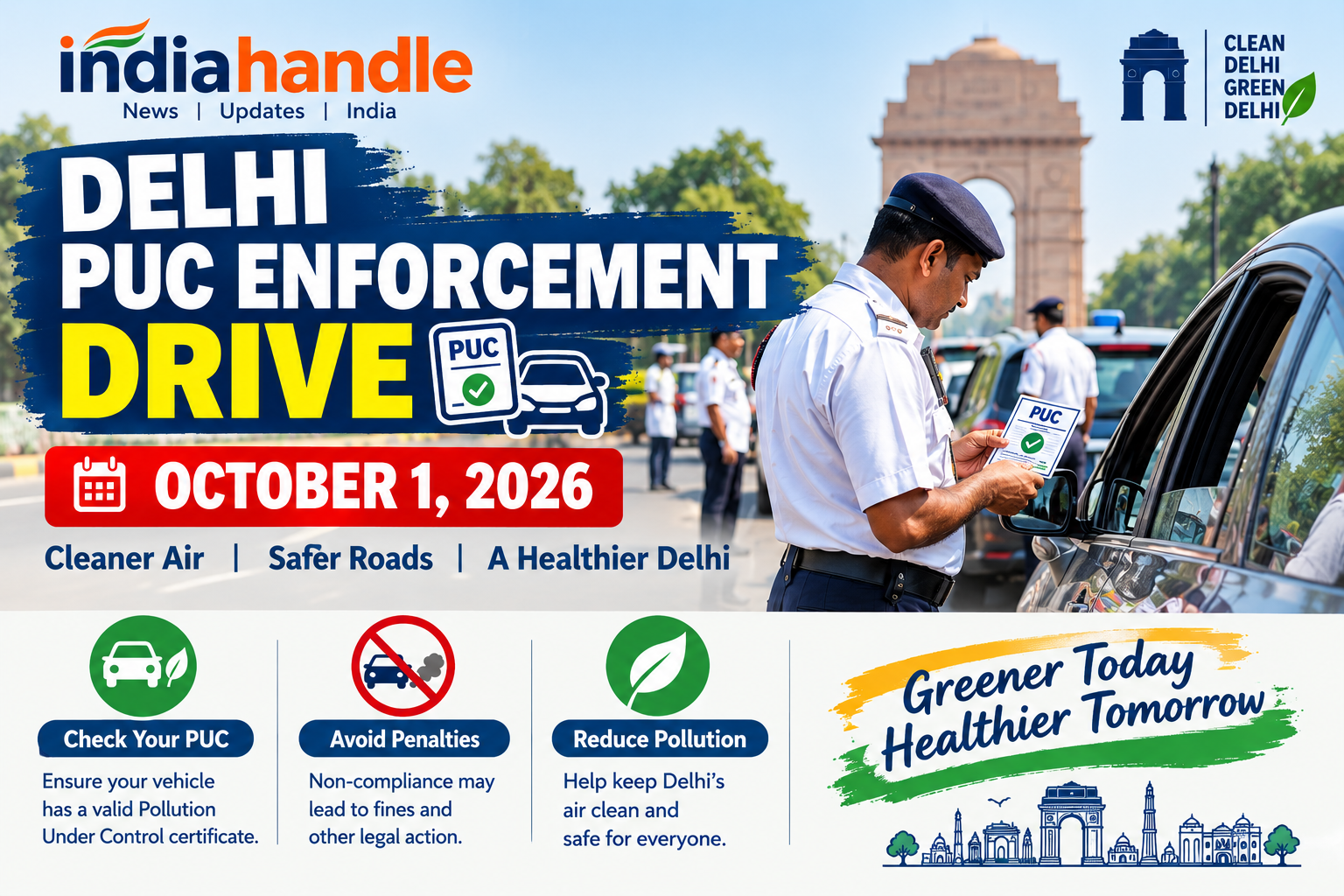
In short: The Delhi government started an enforcement drive on 1 October 2026 against vehicles that do not carry a valid Pollution Under Control (PUC) certificate. Chief Minister Rekha Gupta announced the move on 26 September while inaugurating an Automated Testing Station (ATS) in Burari, which she described as the biggest in the country. The drive is part of a wider Air Pollution Mitigation Action Plan 2026 aimed at cleaner air in the capital.
Key takeaways
- The enforcement drive against invalid PUC certificates began on 1 October 2026.
- The Chief Minister announced it at the opening of the Burari Automated Testing Station on 26 September.
- The government says more commercial vehicles will now be tested and checked against pollution norms.
- The PUC centre system in Delhi is also to be made more effective and reliable.
- The Air Pollution Mitigation Action Plan 2026 covers vehicle rules, electric vehicles and road dust control.
- Penalty amounts were not stated in the reports reviewed, so owners should check the Delhi transport department for the latest rules.
What the Chief Minister announced
Speaking after the inauguration of the Automated Testing Station in Burari, Rekha Gupta said the government wants every person in Delhi to get clean air to breathe. She explained that the enforcement drive will check whether vehicles on the road hold a valid PUC certificate, and she described it as one step in the government’s year-round effort to reduce air pollution.
Gupta also said the system of PUC centres in Delhi would be made more effective and reliable. This matters because the value of any enforcement drive depends on how trustworthy the underlying testing is. If certificates can be obtained without a proper test, checking them on the road achieves little. By promising reforms in the centres themselves, the government is signalling that it wants the certificate to be a real measure of a vehicle’s emissions, not just a piece of paper.
The Chief Minister described the Burari facility as the country’s biggest Automated Testing Station and said it would allow more commercial vehicles to be tested and checked for pollution norms. Commercial vehicles such as trucks and buses are often heavier polluters than private cars, so adding testing capacity for them is a sensible target in a city that struggles with air quality every winter.
What is a PUC certificate and why does it matter?
A Pollution Under Control certificate is a document issued after a vehicle’s exhaust emissions are tested at an authorised centre. It confirms that the emissions are within the permitted limits. In Delhi, carrying a valid certificate is a legal requirement for vehicles, and the new drive focuses on enforcing that rule.
Vehicles that are poorly maintained, or whose engines and filters are not working properly, tend to release more smoke and fine particles. A regular emission test helps owners catch such problems early. For a city where vehicles are one of the commonly cited sources of air pollution, along with road dust, construction activity and seasonal factors, enforcing the certificate rule is one of the more direct tools available to the government.
The bigger plan: Air Pollution Mitigation Action Plan 2026
The PUC drive does not stand alone. According to the government’s press release, Chief Minister Gupta launched the Air Pollution Mitigation Action Plan 2026 earlier this year, shifting the focus towards strict enforcement and measurable results. The plan builds on the Green Budget for 2026-27.
Key measures in the plan include:
- A “No PUC, No Fuel” rule and BS-VI entry norms: These are aimed at making sure that vehicles without valid certificates, and those that do not meet the required emission standard, face practical restrictions.
- A push for electric vehicles: An upcoming EV Policy 2026 will focus on two-wheelers and commercial vehicles, and will move government fleets towards cleaner fuels.
- Road dust control: The government is deploying mechanical road sweepers, water sprinklers and anti-smog guns on a large scale, since road dust is a major pollutant.
- Accountability: The Chief Minister said the plan has financial backing, strict timelines and accountability at every level.
The money behind it
Delhi’s budget for 2026-27 has a total outlay of about ₹1,03,700 crore, and 21% of it has been earmarked as a “green budget” to support environmental initiatives. The Chief Minister has also said that every policy in the budget takes environmental impact into account. Alongside, the allocation for the fire department was raised from ₹530 crore to ₹674 crore.
Budget allocations show intent, but the real test is how quickly the money translates into cleaner roads, better testing centres and fewer polluting vehicles on the streets.
What vehicle owners should do now
If you own a vehicle in Delhi, a few simple steps can save you trouble during the enforcement drive:
- Check your certificate today. Look at the validity date printed on your PUC certificate. The validity period can depend on the type and age of the vehicle, so go by the date on the document.
- Renew early. Visit an authorised PUC centre before the certificate expires. Do not wait for the last day, because queues tend to grow when enforcement starts.
- Keep proof handy. Carry the certificate, or a digital copy, whenever you drive.
- Maintain your vehicle. Regular servicing, clean air filters and the right fuel help a vehicle pass its emission test.
- Check official sources for penalties. The reports reviewed did not state fine amounts or the exact checking process, so confirm these on the Delhi transport department’s website or helplines.
Fleet operators and commercial vehicle owners should take extra care. Since the new testing station is aimed at checking more commercial vehicles, they are likely to see closer attention.
Why the timing matters
The drive starts just as the cooler months approach. Air quality in Delhi and the surrounding region commonly worsens in the weeks after the monsoon, when lower wind speeds and colder air let pollutants build up. Starting enforcement on 1 October gives the government a few weeks to push vehicle owners towards compliance before the worst of the season arrives.
Critics may ask whether one drive can make a visible difference on its own, and experts generally agree that no single measure will clean the air. Vehicle emissions, road dust, construction, industry and regional factors all play a role. What the enforcement drive does is address the part that the city government can directly control: the vehicles registered and driven on its roads.
What to watch next
Several things will show whether the drive works. How many vehicles are checked, and how many are found without valid certificates? Will the promised reforms in PUC centres actually make testing more reliable? How quickly will the EV Policy 2026 arrive, and what will it offer to two-wheeler and commercial vehicle owners? And will road sweeping, sprinklers and anti-smog guns be used consistently, or only on the worst days?
For Delhi residents, the practical message is simple. Check your PUC certificate now, renew it if it is close to expiring, and keep your vehicle well maintained.
Frequently asked questions
When did the PUC enforcement drive start in Delhi? It began on 1 October 2026, as announced by Chief Minister Rekha Gupta on 26 September.
What is a PUC certificate? It is a certificate issued after an emissions test, showing that a vehicle’s exhaust emissions are within permitted limits.
What is the Burari Automated Testing Station? It is a vehicle testing facility inaugurated by the Chief Minister, who described it as the country’s biggest. The government says it will help test more commercial vehicles for pollution norms.
What is the “No PUC, No Fuel” rule? It is one of the measures in the Air Pollution Mitigation Action Plan 2026, aimed at linking fuel supply to a valid PUC certificate.
How much is the fine for not having a valid PUC certificate? The reports reviewed did not state the amount. Please check the Delhi transport department for the current penalty.
SEO and publishing details
SEO title: Delhi PUC Enforcement Drive 2026: What Owners Must Know
Meta description: Delhi began its PUC enforcement drive on 1 October 2026. Know what the rule means, what to do now, and how the Action Plan 2026 fits in.
Slug: /delhi-puc-enforcement-drive-october-1-2026
Focus keyword: Delhi PUC enforcement drive
Tags: PUC certificate, Delhi pollution, Rekha Gupta, Delhi air quality, Burari, Action Plan 2026, EV Policy
Featured image: delhi-puc-enforcement-drive-october-1-2026.jpg
Image alt text: Vehicle emission testing in Delhi as the PUC enforcement drive begins on 1 October 2026



Leave a Reply