Jantar Mantar Protest: Delhi Police Detain AAP’s Saurabh Bharadwaj as ‘Save Democracy’ Campaign Begins
India Handle Desk · Delhi News · 2 October 2026
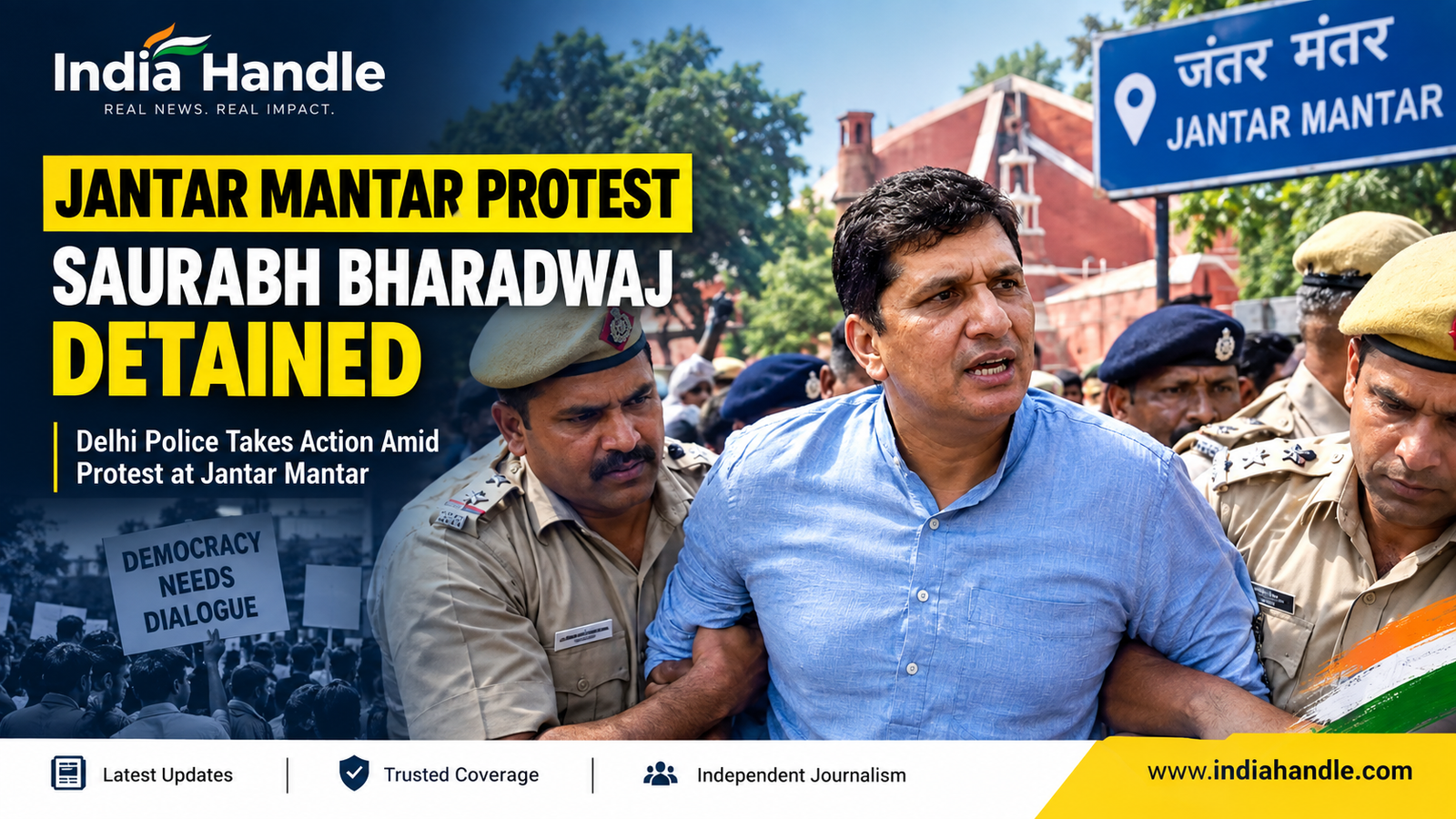
In short: Delhi Police detained AAP Delhi unit president Saurabh Bharadwaj and several party workers at Jantar Mantar on Friday, 2 October 2026, as an opposition protest against the Election Commission ran into heavy restrictions. Police had refused permission for the gathering and imposed Section 163 of the Bharatiya Nagarik Suraksha Sanhita (BNSS) across the New Delhi district. The protest marks the start of a week-long “Save Democracy” campaign announced by the INDIA bloc.
Key takeaways
- Delhi Police detained Saurabh Bharadwaj and AAP workers at Jantar Mantar on 2 October 2026.
- Police denied permission and imposed Section 163 of the BNSS in the New Delhi district, citing public safety, public order and smooth traffic movement.
- The protesters demand action against Chief Election Commissioner Gyanesh Kumar over the Special Intensive Revision (SIR) of electoral rolls.
- The INDIA bloc has announced “Save Democracy” marches and demonstrations from 2 to 8 October.
- The allegations come from opposition parties. The Election Commission has defended the revision as part of efforts to clean up the electoral rolls.
What happened at Jantar Mantar on 2 October
The call for the protest came from student organisations, including the All India Students’ Association (AISA) and the Students’ Federation of India (SFI). The Rashtriya Janata Dal, the Congress and the Aam Aadmi Party were also expected to take part. AAP leaders Atishi and Sanjay Singh had urged supporters to reach Jantar Mantar at 10 am on Friday, a day before the event, even though the police had not granted permission.
On the day, the area around the protest site was heavily barricaded and security was tight. Police began taking people into preventive custody as they approached Jantar Mantar. Among those detained was Saurabh Bharadwaj, the president of AAP’s Delhi unit, along with a number of party workers. The police said the situation was under control.
Bharadwaj criticised the security arrangements in the capital, saying Delhi had been turned into a fortress. He also pointed out that he had reached the venue by Metro and an auto-rickshaw for a total of ₹91, arguing that if he could get there, other supporters could too. AAP chief Arvind Kejriwal did not turn up at the protest site.
Section 163 of the BNSS: what the restrictions mean
Section 163 of the Bharatiya Nagarik Suraksha Sanhita allows authorities to issue orders to prevent disturbances of public order. It is the provision that took over the role of Section 144 of the old Code of Criminal Procedure. In this case, the police order covered the whole New Delhi district.
The order prohibits unauthorised gatherings, public speeches, slogan shouting, processions, demonstrations and dharnas. Police said the restrictions were needed for public safety, the maintenance of public order and the smooth movement of traffic. They urged people to follow the order and cooperate, warning that violations could invite legal action.
Why the opposition is protesting: SIR and the Chief Election Commissioner
The Special Intensive Revision, or SIR, is an exercise by the Election Commission to update and verify electoral rolls. The opposition says the exercise has been carried out in a way that removes genuine voters from the lists. At the heart of the protest is a demand for the resignation of Chief Election Commissioner Gyanesh Kumar.
AAP MP Sanjay Singh alleged that 1.37 crore names had been deleted from electoral rolls in the name of SIR. AAP’s call for the protest also used the phrase “vote theft”. These are political allegations made by opposition leaders. The Election Commission has defended the revision as part of its efforts to clean up the rolls, and readers should treat the figures cited by either side as claims until they are verified through official data.
The INDIA bloc’s week-long ‘Save Democracy’ campaign
The Jantar Mantar protest sits inside a larger plan. After a meeting of INDIA bloc leaders in New Delhi on 30 September, the opposition announced a week-long nationwide “Save Democracy” campaign running from 2 to 8 October. Congress president Mallikarjun Kharge said the marches would involve young people and non-governmental organisations, and that demonstrations would be held in front of district magistrate offices.
The campaign will try to take concerns about SIR directly to voters through district-level marches and gatherings. Separate protests by student and civil-society groups, seeking action against the Chief Election Commissioner, have also been planned in Delhi, Mumbai and other parts of the country.
Jantar Mantar: Delhi’s designated protest ground
Jantar Mantar has a particular place in the capital’s political life. It sits close to Parliament and the centres of power, and it is one of the few places in central Delhi where protests are officially allowed. In the early 1990s, protesters could still march along Rajpath. As restrictions grew, the authorities designated Jantar Mantar as one of the limited places where people could gather. Campaigners often choose it because it is easy for journalists around Parliament to reach.
This is why Friday’s restrictions drew attention. When even the designated protest site is barricaded and an order bans gatherings across the district, the debate quickly moves from the original issue to the question of how much space remains for peaceful dissent. Supporters of the police action say public order and traffic management must come first. Critics say the right to protest peacefully is a basic feature of democracy. Both arguments are part of the public conversation, and courts have often been asked to balance them.
Positions of the main players
AAP: Party leaders called on supporters to reach Jantar Mantar and described the protest as one against “vote theft”. Bharadwaj said the city had been turned into a fortress and urged workers to come regardless.
Delhi Police: Officials said permission was not granted and that Section 163 restrictions were needed for public safety, public order and traffic. They said the situation was under control and that activists were being detained as they reached the protest site.
Election Commission: The Commission has defended the revision of electoral rolls as a clean-up exercise.
INDIA bloc: Opposition parties are treating the Jantar Mantar protest as the first step of a wider campaign through 8 October.
What to watch next
Several questions will decide how this story develops over the coming week. Will the district-level marches and demonstrations proceed peacefully, and will local administrations grant permission? Will more detentions follow in Delhi and other cities? How will the Election Commission respond to the specific numbers and allegations raised by the opposition? And will the issue move to courts or Parliament as the campaign continues?
For now, the sequence of events on 2 October shows how contested the electoral roll revision has become, and how quickly the argument has spilled from political statements onto the streets of the capital.
What this means for Delhi residents
Residents of the New Delhi district should expect heavy security and possible traffic diversions around Jantar Mantar and nearby areas while the restrictions remain in force. Commuters are advised to check official Delhi Traffic Police advisories before travelling and to follow police instructions in the area. People who are not part of any protest are not affected by the order, but unauthorised gatherings and processions in the district can invite legal action.
Frequently asked questions
Who was detained at Jantar Mantar? Delhi Police detained AAP Delhi unit president Saurabh Bharadwaj and several party workers on 2 October 2026.
Why did police stop the protest? Police said they had not granted permission and imposed Section 163 of the BNSS in the New Delhi district, citing public safety, public order and traffic movement.
What is the Special Intensive Revision (SIR)? SIR is the Election Commission’s exercise to update and verify electoral rolls. The opposition alleges that it has led to the wrongful deletion of voters, while the Commission has defended it as a way to clean up the rolls.
What is the ‘Save Democracy’ campaign? It is a week-long campaign by the INDIA bloc, from 2 to 8 October 2026, with marches and demonstrations in front of district magistrate offices.
Did Arvind Kejriwal attend the protest? No. AAP chief Arvind Kejriwal did not turn up at the Jantar Mantar protest site.

Leave a Reply